2026 NFL Draft: There's A Tight End For Everyone

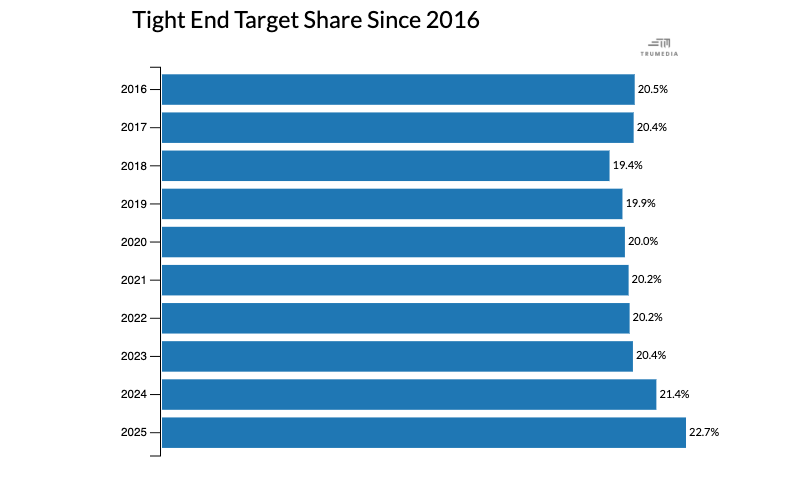
Tight ends have become more important than ever in the modern NFL. Last year, 22.7% of passes league-wide were thrown to tight ends. That’s the highest mark of the past decade.
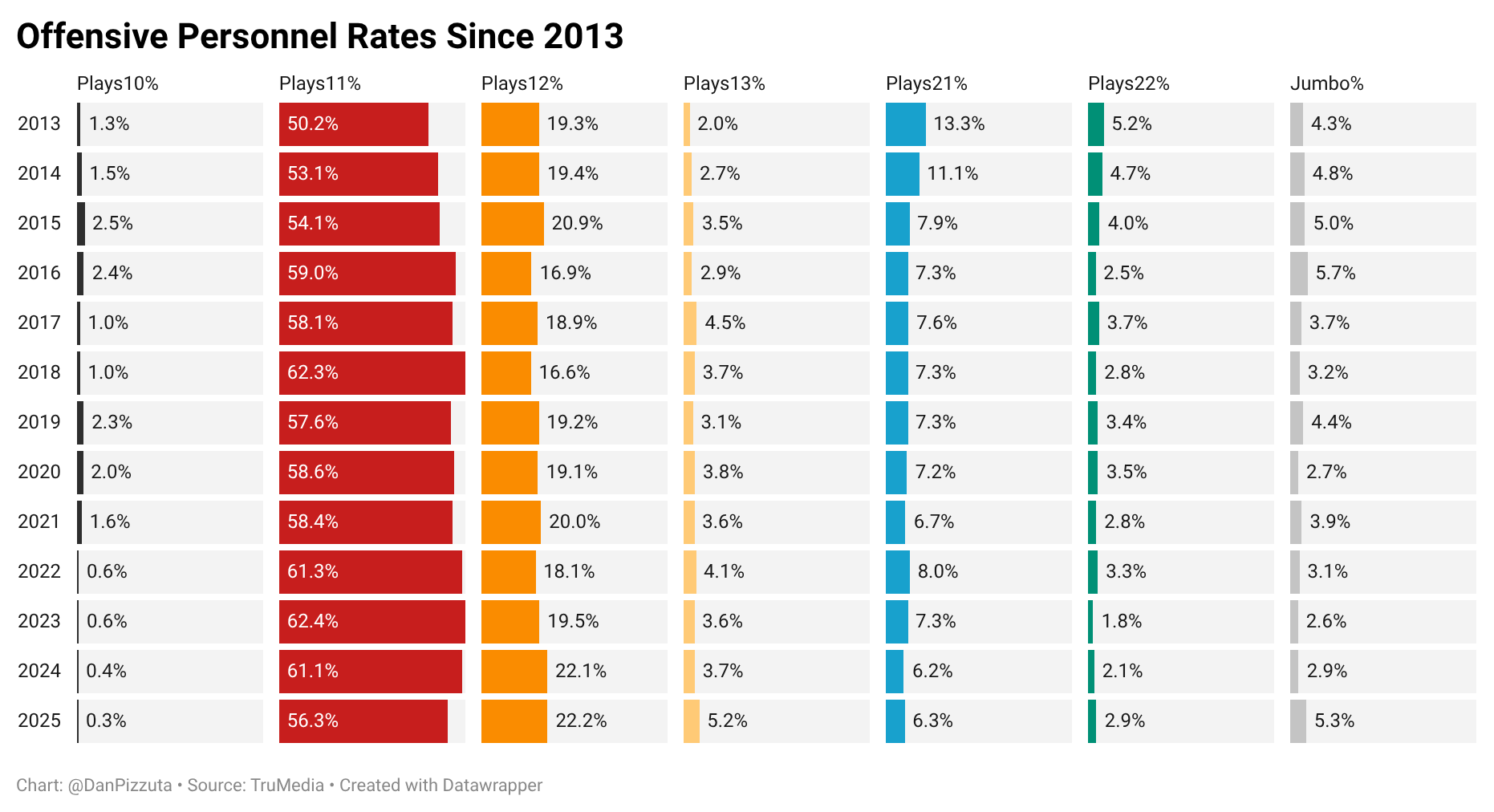
More tight ends are also on the field more often. One of the most covered schematic trends during the 2025 season was about how the Los Angeles Rams leaned into 13 personnel, but deploying more tight ends was a league-wide effort. With NFL offenses wanting to get heavy in an attempt to get bigger bodies on the field against nickel defenses or force defenses into using more linebackers to match the size, offenses leaned more on tight ends — a big difference from when offenses would use a fullback and two-back sets to set the tone, even earlier this decade. While 11 personnel still makes up for more than half of the league’s offensive plays, three-receiver sets had a relatively massive drop from 61.1% in 2024 to 56.3% in 2025, the lowest rate since 2015. Meanwhile, the league had its highest rates of 12 and 13 personnel during the 2025 season.
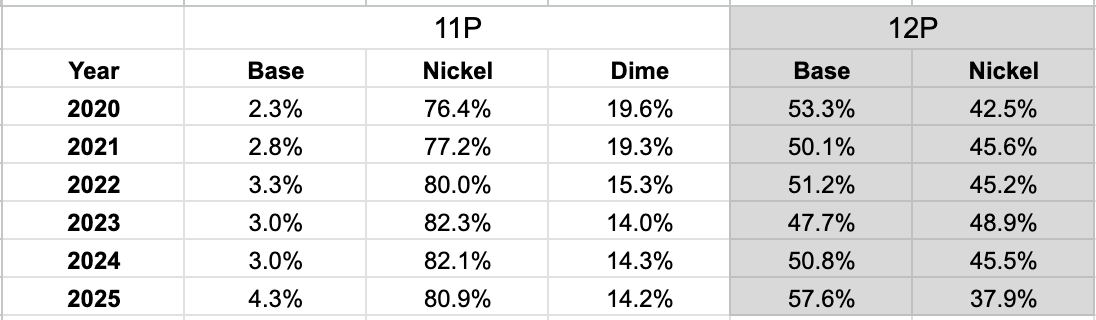
It’s not just that offenses are using tight ends differently; defenses have changed their approach to those multiple-tight-end sets. From 2021-2024, defenses matched 12 personnel with four defensive backs on the field around half the time. That jumped all the way up to 57.6% in 2025.
That push-and-pull of fighting for personnel advantage is why the tight end position and the player skill set have become increasingly important. For those multiple-tight-end sets to work, the offense needs to present an equal threat of the run and the pass. Last season, the league’s pass rate from 12 personnel was 49%. The Rams were able to rely on 13 personnel so often because they had a 48.1% rushing success rate, which allowed them to keep it on the field and then take advantage of the passing mismatches for a 57.6% success rate. But we’ve also seen how much a dynamic, pass-catching tight end can change an offense.
Historically, the position took two to three years for a player to develop into the wide-ranging responsibilities of the role; we’ve seen more tight ends come into the league and produce immediately in recent years. Last year’s draft class included Colston Loveland, Tyler Warren, and Harold Fannin, who came in and became significant pieces of their offenses.
Offensive coaches around the league are getting better at putting these players in a position to succeed and not forcing them into roles that might be outside of their comfort zone early in their careers. It also helps that incoming rookies have been pretty good and easy to implement into offenses. This year’s tight end class might not have the same juice at the top as the Colston/Warren duo, but there is still a deep group of prospects with a wide range of skills. This class — as has become the norm at receiver and could become the case for future tight end classes — has something for everyone. Knowing how (and how not) to use these players requires an understanding of what they are coming into the league.
The Star
The top tight end in this class, and the only expected first-round pick, is Oregon’s Kenyon Sadiq. Sadiq isn’t the biggest, coming in at 15th-percentile height and ninth-percentile weight for the position, but he put up what might have been the best testing for a tight end at the combine with a 98th-percentile forty, 99th-percentile vertical, and 98th-percentile broad jump. Athleticism doesn’t guarantee success as a tight end, but just about every top tight end in the league is a plus athlete.
Sadiq doesn’t have overwhelming receiving production because of how much the Oregon offense spreads the ball around, but it’s clear how explosive he can be with the ball in his hands. Last season, Sadiq led this class with 13 receptions of 20 or more yards. Because of his explosiveness and receiving efficiency, Sadiq not only has the highest projection in FTN’s Travis system for this class, but also the highest for a tight end prospect since at least 2001.
Defenses still want to put bigger bodies on Sadiq, even if it’s still a defensive back. Here he is against a 6-foot-2 safety against USC in the red zone.
Kenyon Sadiq - slot vs SAF in red zone
— Dan Pizzuta (@danpizzuta.bsky.social) 2026-03-29T21:43:20.681Z
Despite the size/speed mismatches, Sadiq did most of his damage against zone coverage in 2025. He has a feel for space and can create big plays when that happens against zone. Sadiq had 1.94 yards per route run and a 22.4% explosive play rate of 20 or more yards.
He spent about 43% of his time lined up inline and he’s a willing enough blocker to make his time there work. He’s not going to be a dominating presence as a blocker, but his effort will be passable in the run game and no team is drafting him to keep him in on pass plays.
The Slot Options
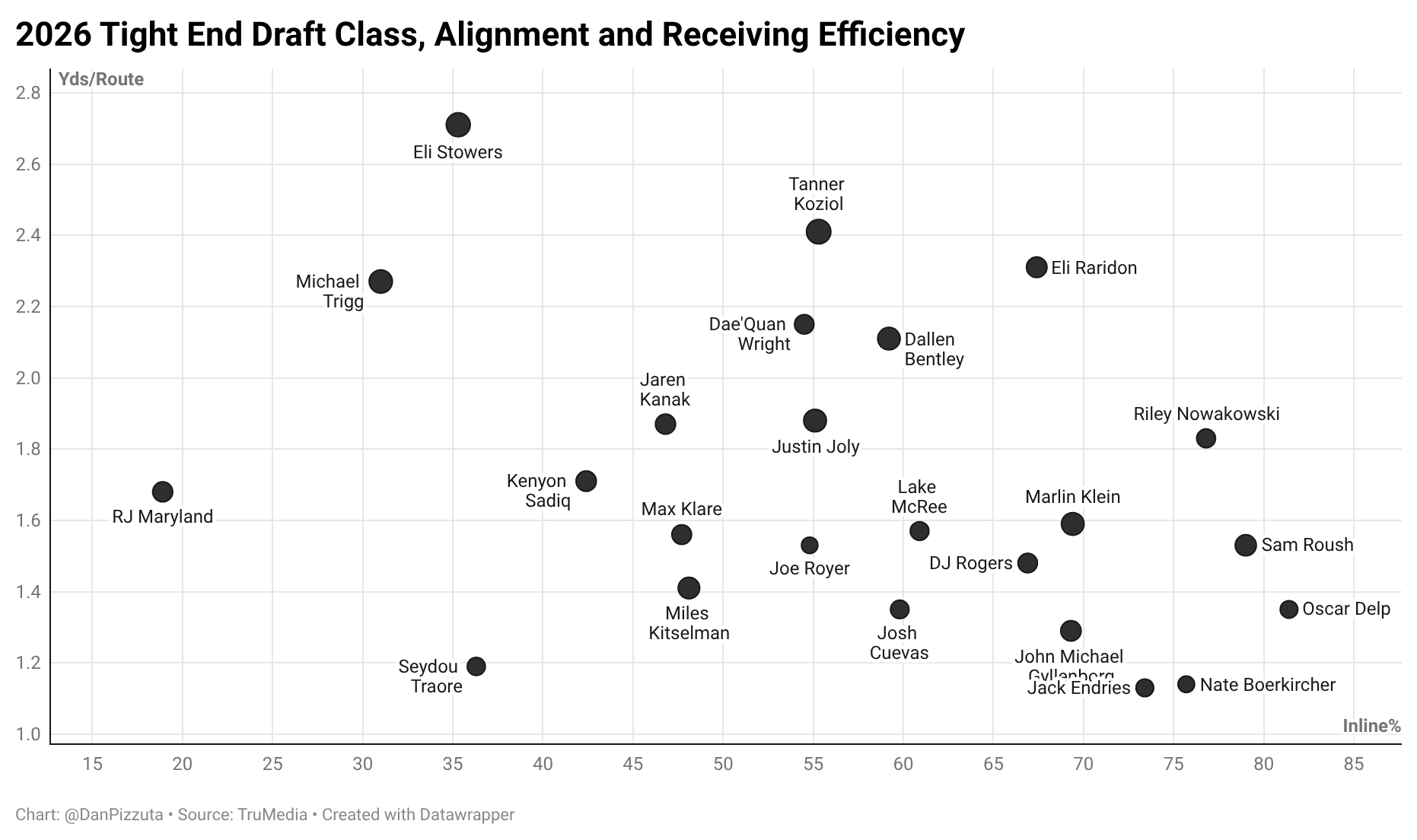
The second tight end in this class, by most rankings, is Eli Stowers of Vanderbilt, who raises the question of where the line is between a big receiver and a small tight end. Stowers, at 6-foot-4 and 239 pounds, came into college as a quarterback and converted to tight end. He is a certifiably tested athletic freak with 99th-percentile vertical and broad jumps. However, he’s just in the eighth percentile in weight, which kept him mostly in the slot. Last season, 55.1% of Stowers’s snaps came in the slot with just 35% inline.
Last year, of the 73 NFL tight ends who ran at least 200 routes, just five played inline on 35% or fewer of their snaps — Dalton Kincaid, Isaiah Likely, Darren Waller, Mark Andrews, and Mike Gesicki. That puts him in a specific bucket of players and even within that, there are layers. Can Stowers be closer to a healthy version of Kincaid, who was inline for 35% of his snaps yet was the top tight end in yards per route run (2.83). Or will he have to be closer to Gesicki at the NFL level, who was inline on just 9.7% of his snaps and was only 41st in yards per route run — both clogging up a spot in the alignment and not being an efficient enough pass catcher to make up for it?
The passing game production doesn’t look like it should be an issue. His 2.71 yards per route run in 2025 led this tight end class and 64.5% of his receptions went for a first down or touchdown, which was seventh in the class. There are also pros and cons of where Stowers is in his development as a tight end, being relatively new to the position. He doesn’t have a ton of experience against man coverage. While he was targeted on 33.8% of routes against man coverage in 2025 and had a respectable 1.92 yards per route run, he only averaged 8.7 yards per reception. He didn’t have a ton of breakaway ability, with just 3.2 yards after the catch per reception and no catches of 20 or more yards. However, he has a clear feel for zone coverage, averaging 3.04 yards per route run and recording eight catches of 20 or more yards in 2025.
Can he block? That’s going to be the determining factor of where he plays and how often he can stay on the field. Vanderbilt didn’t always trust Stowers as a blocker, and he was on the field for only 58.8% of the team’s offensive snaps. Stowers isn’t going to be on any teach tape for blocking and he isn’t always effective in controlling the point of attack, but he has a willingness to at least get in the way, which works. Per Sports Info Solutions, Stowers had a 0% blown block rate against the run and the pass. Even if he’s not going to be a dominant blocker, he might not be a complete liability and he still has room for development in that area, which could increase his ceiling and allow him to be on the field more often for his NFL team.
Baylor’s Michael Trigg has a similar profile. Trigg was inline on just 31% of his snaps and was in the slot on 64.9%. Trigg has a massive wingspan, 99th percentile at nearly 85 inches, that expands his catch radius and allows him to out-reach smaller defenders in coverage. With his size and speed, he has a vertical element to his game that is unmatched among the other tight ends in this class. Trigg had 43 targets of at least 10 air yards, while the next tight end in this class had 28.
Baylor TE Michael Trigg had more targets of 10+ air yards in 2025 than KC Concepcion, Makai Lemon, and Carnell Tate.
— Dan Pizzuta (@danpizzuta.bsky.social) 2026-04-03T18:05:01.615Z
Trigg could be a player who gets more work in traditional alignments as he gets to the NFL and away from the spread Baylor system. However, his 2.4% blown block rate in the run game ranked 25th among tight ends and would need to improve for him to see more snaps away from the slot.
The Traditionals
Looking for traditional tight ends, who will play a majority of their snaps inline? There are plenty of those, too. We’ll highlight three from this group.
The first is Sam Roush from Stanford. At 6-foot-6 and 267 pounds, Roush combines size with the explosiveness of a 94th-percentile vertical jump and 94th-percentile broad. He was one of four tight ends in this class to eclipse a 20% target share in his offense and was on the field for a class-high 80% of his team’s dropbacks. Roush did all of that while he was inline on 79% of his snaps. The Stanford offense was not a fun watch (117th in SP+) and that didn’t allow Roush to have great receiving production — 17.5% of his targets were considered inaccurate — but he’s also one of the best blockers in this class, which should at least allow him to get on the field early and grow into a bigger pass-catching role.
Notre Dame’s Eli Raridon is also 6-foot-6, but listed at 240 pounds. His slightly smaller frame doesn’t stop him from being a force as a blocker with just a 1% blown block rate on the ground, per SIS. Raridon was third in this class by yards per route run (2.31) and 20.5% of his plays went for 20 or more yards. That mix of blocking ability and explosion in the passing game, makes him a perfect player off play-action. Notre Dame kept extra blockers in on play-action and Raridon stayed in on 63% of his play-action snaps, but he averaged 3.63 yards per route when he went out on play-action.
Notre Dame TE Eli Raridon was asked to stay in and block so often on play-action that sneaking him out was a big play waiting to happen with the defense losing him.
— Dan Pizzuta (@danpizzuta.bsky.social) 2026-04-05T23:15:28.509Z
No tight end spent more time lined up inline than Georgia’s Oscar Delp at 81% of his snaps, but he also might be the biggest projection in this class. During the 2025 season, Delp only ran a route on 39.3% of Georgia’s overall dropbacks. He only ran a route on 63.9% of the dropbacks when he was on the field, a rate higher than only Indiana’s Riley Nowakowski’s 56%. Delp didn’t run at the combine, but was reportedly in the 4.4s at the Georgia Pro Day. That athleticism shows when he’s running down the seam, but that wasn’t a big part of his game. It wasn’t as if Delp was some efficiency monster on the routes he did run. He was target on just 14.5% of his routes. Nearly half of his 28 targets in 2025 came on crossing routes, which accounted for a class-high 22.3% of his routes.
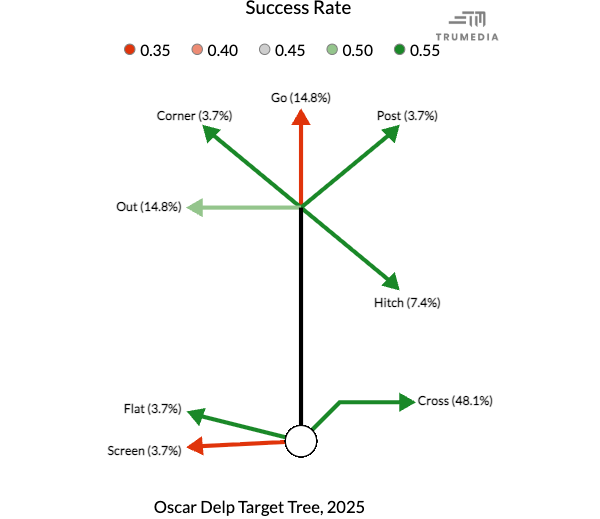
Delp also isn’t that big, certainly not the size one would expect for a tight end who was asked to block as often as he did. He weighed in at 245 pounds, which is in the 20th percentile for the position, and he only had a 10th-percentile arm length. He might be the biggest projection of this group, as NFL teams have to ask why he wasn’t a bigger part of the passing offense as a receiver and if the potential is worth a bet when there is such depth at the position.
The Movers
There are a ton of intriguing “move” tight end prospects in this class — players who can bounce between the slot, inline, and out wide.
Ohio State’s Max Klare is widely viewed as the No. 3 tight end in this class behind Sadiq and Stowers, and is there on The Athletic’s most recent consensus big board. Klare’s receiving production at Ohio State was just fine — he arguably had the toughest teammate competition of any player in this class — but what stands out about Klare’s production was how he did it. Of his 55 targets, 41.8% came inline, 40% came in the slot, 10.9% came outside, and 7.3% came from the backfield. That versatility, while staying productive as a pass catcher and engaging as a blocker would make him an instant fit in any offense.
Justin Joly from NC State is another player who can do a little bit of everything. He has a smoothness to his game that allows him to create late separation and his 91st-percentile hand size shows up when he needs to make contested catches against defenders. The route running will allow Joly to get on the field early and build rapport with his quarterback while the rest of his game continues to develop.
Two potential Day 3 tight ends stick out as players who could outplay their draft status. One is Houston’s Tanner Koziol. Koziol is big at nearly 6-foot-7 and he moves well for that size. He led this tight end class with 94 targets and was second in yards per route run (2.41) behind Stowers. Koziol was often asked to be a motioned blocker, which carried over into the passing game. He ran a route on 78.6% of the dropbacks when he was on the field. But he was targeted on a class-high 31.1% of his routes and led this position group with a 28.6% target share.
Intrigued by HOU TE Tanner Koziol. - Big dude: 6-foot-7 - Smooth mover that allows him to set up defenders and find space without top-end speed - Second-most YPRR in this TE class - Willing blocker who could be asked to do less as a pass blocker in the NFL than he was in college.
— Dan Pizzuta (@danpizzuta.bsky.social) 2026-03-23T18:38:05.378Z
He has the chance to be a bigger part of a passing game with his NFL offense asking him to do less blocking on pass plays than he was asked to in college, but he can still contribute as a blocker when asked. The type of passing game production could also increase in a professional offense. Koziol only had a 6.93 aDOT, but accounted for 20.3% of Houston’s receiving air yards, which was second among tight ends in this class.
Utah’s Dallen Bentley is one of the most fascinating prospects. Bentley started his college career as a JUCO walk-on and had three catches for 30 yards in his first two years with the Utes. But he broke out in 2025 as a major part of the passing game, accounting for a 21.8% target share and 2.11 yards per route run, which ranked sixth in this class. The biggest knock on Bentley is that he turned 25 years old on January 1. For comparison, Kenyon Sadiq just turned 21 years old in March.
Bentley still comes out second in this class by Travis projections and it’s partly due to how much he contributed to the Utah passing game this past season. He ran the highest rate of hitch routes (31.3% of his routes), but that was often about getting him into space and allowing him to work. Bentley has a great feel for finding voids and making himself available to the quarterback.
Utah TE Dallen Bentley can be a nice target when he slides into open space
— Dan Pizzuta (@danpizzuta.bsky.social) 2026-04-01T17:52:52.126Z
Per SIS, Bentley was also the best blocker in this class by their blocker rating and he was third in their total points metric with no blown blocks as a pass protector and a 0.7% blown block rate on the ground. “Best” might not be completely accurate, but he has strong technique to be in the right spot, even if he isn’t a physically imposing presence on the line of scrimmage.
Other tight end notes
- Dae’Quan Wright (Ole Miss) averaged 10.1 YAC per reception and 21.4% of his targets went for 20 or more yards.
- Lake McRee (USC) was inline on 60% of his snaps and ran a go route on 18.1% of the time (fourth). 70% of his receptions went for a first down or touchdown (second).
- Miles Kitselman (Tennessee) was in the backfield on 30.6% of his snaps.
- John Michel Gyllenborg (Wyoming) had a 96th-percentile broad jump and 82nd-percentile short shuttle.