8 Questions For The Conference Championship Games


It's Championship Weekend with four teams remaining. As we get set to see which of these teams will make it to the Super Bowl, let's look at a few questions surrounding the two conference championship games and how those could impact the results.
Patriots vs Broncos
AFC Championship Game
Can Jarrett Stidham handle the blitz?
The biggest unknown in the AFC Championship Game is what the Denver offense will look like with Jarrett Stidham at quarterback. The Broncos were one of two teams, along with the Rams, to not have a backup quarterback attempt a pass during the regular season. Stidham hasn’t thrown a meaningful pass since 2023 and only has four starts in his six-year career.
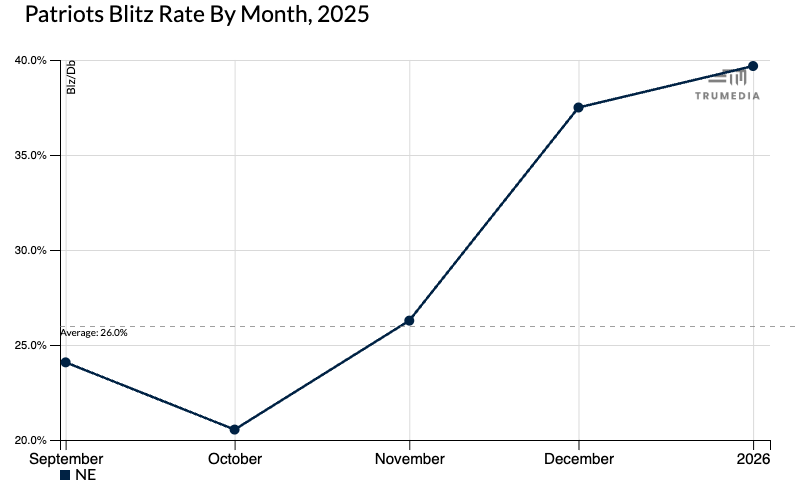
New England’s defense is going to make Stidham think quickly by bringing pressure. The Patriots have become one of the league's heaviest blitzing teams, with the blitz rate increasing every month of the season — jumping to over 40% since December.
In 65 career dropbacks against the blitz, Stidham has averaged -0.34 EPA per play with a 33.8% success rate.
Nix’s best trait as an NFL quarterback has been his aversion to taking sacks. He is willing to get out of the pocket when necessary (sometimes when not) and the Broncos have built bootlegs into the offense to take advantage of the quarterback’s mobility. Stidham doesn’t have that same mobility. When pressured, Stidham has held onto the ball longer and tried to push the ball down the field.
But another way to beat the rush has been getting the ball out quickly on swings and screens. Against the blitz, Nix threw at or behind the line of scrimmage on 28% of his throws, which was the fifth-highest rate among quarterbacks. This could be a designed way to protect Stidham, but the Patriots ranked fifth in EPA per play against throws at or behind the line of scrimmage in the regular season.
Do the Broncos go big in the slot?
If there’s a place in the passing game where the Broncos could match up well with the Patriots, it’s over the middle of the field. New England’s linebackers have played significantly better in the playoffs than they did during the regular season, but testing Robert Spillane and Christian Elliss in coverage is still a better option than testing New England’s outside corners.
By avoiding the outside corners, the Broncos may lean more into throwing to slot targets. In this matchup, putting Courtland Sutton there could give the Broncos their biggest advantage. Sutton has played around 15% of his snaps in the slot. When he’s lined up there, it’s been done with intention. He has a tight target share and has been targeted at a higher rate of his routes from the slot. By yards per route run, he’s also been a little more efficient inside this season.
Marcus Jones is a good slot corner, but asking the 5-foot-8 defender to consistently cover the 6-foot-4 Sutton for a majority of his snaps could be a tough ask. Troy Franklin and Pat Bryant have been Denver’s main slot receivers throughout the season. Both suffered injuries against Buffalo, but have practiced this week. At 6-foot-2, Bryant could serve a similar role, but it could be more beneficial to have the team’s top receiver in that big slot role that Sean Payton has used so well throughout his career, going back to Marques Colston in New Orleans.
How impactful can pressure be against Drake Maye?
In last week’s Divisional Round game against the Houston Texans, C.J. Stroud finished with a higher success rate (34.6%) than Drake Maye (29.4%). Stroud’s plays looked worse, but Maye struggled against pressure. That all came while Maye wasn’t pressured all that often. Maye was only pressured on 24.2% of his dropbacks, but he was sacked on 62.5% of those pressures. When Maye was pressured against Houston, he was 1-for-2 with six sacks and three fumbles. The threat of pressure also screwed with Maye. While he was second in EPA per play and first in success rate when not pressured during the regular season, Maye had just a 34.6% success rate when not pressured against the Texans.
Maye has been sacked on 22.8% of his pressures between the regular season and playoffs. It’s been the one issue in his game. For most of the year, the sacks didn’t derail the offense. Maye had the eighth-best EPA per play on sacks and 68.1% of his sacks lost -1.0 EPA or more, the seventh-lowest figure in the league. But against the Texans, it was a mess.
Denver has a similar pass rush to Houston, but potentially with even more interior pressure. Nik Bonitto and Jonathan Cooper had two of the fastest pass-rush get-offs among edge rushers, and Bonitto was second in quick pressures during the regular season. Zach Allen was ninth in overall pressures during the regular season and led the Divisional Round in pressures.
The Broncos have a 10.1% sack rate between the regular season and playoffs. That’s the second-highest rate for a defense through the Divisional Round in the past decade, behind the 2022 Philadelphia Eagles at 11.4%.
Will the tight ends go off?
Like the Patriots, the Broncos are a better defense on the outside. Patrick Surtain has reliably been one of the best cornerbacks in the league for multiple seasons and while Riley Moss can get caught because he’s thrown at so often playing opposite Surtain, he can make splash plays that are positive for the defense. During the regular season, the Broncos were eighth in EPA per play on targets to wide receivers, but 19th on targets to tight ends.
Maye had a league-average rate of the percentage of his throws to tight ends, but ranked sixth in EPA per play when he threw at the position. Hunter Henry was ninth among tight ends in yards per route run during the regular season and tied for second in receptions of 20 or more yards at the position. The Broncos haven’t been susceptible to explosives against tight ends, allowing the second-lowest rate in the league, but they were 14th in EPA per play against tight end targets within 10 yards of the line of scrimmage and 23rd on targets of 11 or more air yards. Henry was seventh among tight ends in targets of 11 or more air yards during the regular season.
Rams vs Seahawks
NFC Championship Game
Can Sam Darnold solve the Rams?
Against 13 teams that Sam Darnold has played this season, he averaged 0.15 EPA per play with a 50.5% success rate. Against the Rams, Darnold has averaged -0.23 EPA per play with a 46.5% success rate. The relatively small dip in success rate could be something the Seahawks hold onto in hopes that Darnold can keep his game from spiraling, but no defense has been better at getting Darnold to look like the early-career version of the quarterback than the Rams.
Darnold has only gotten pressured a little more in games against the Rams (34% to 38%) and his pressure-to-sack rate is lower (12.5%) than against non-Rams opponents (16.1%), but the Rams have been so good at making Darnold doubt what he’s seeing on the field.
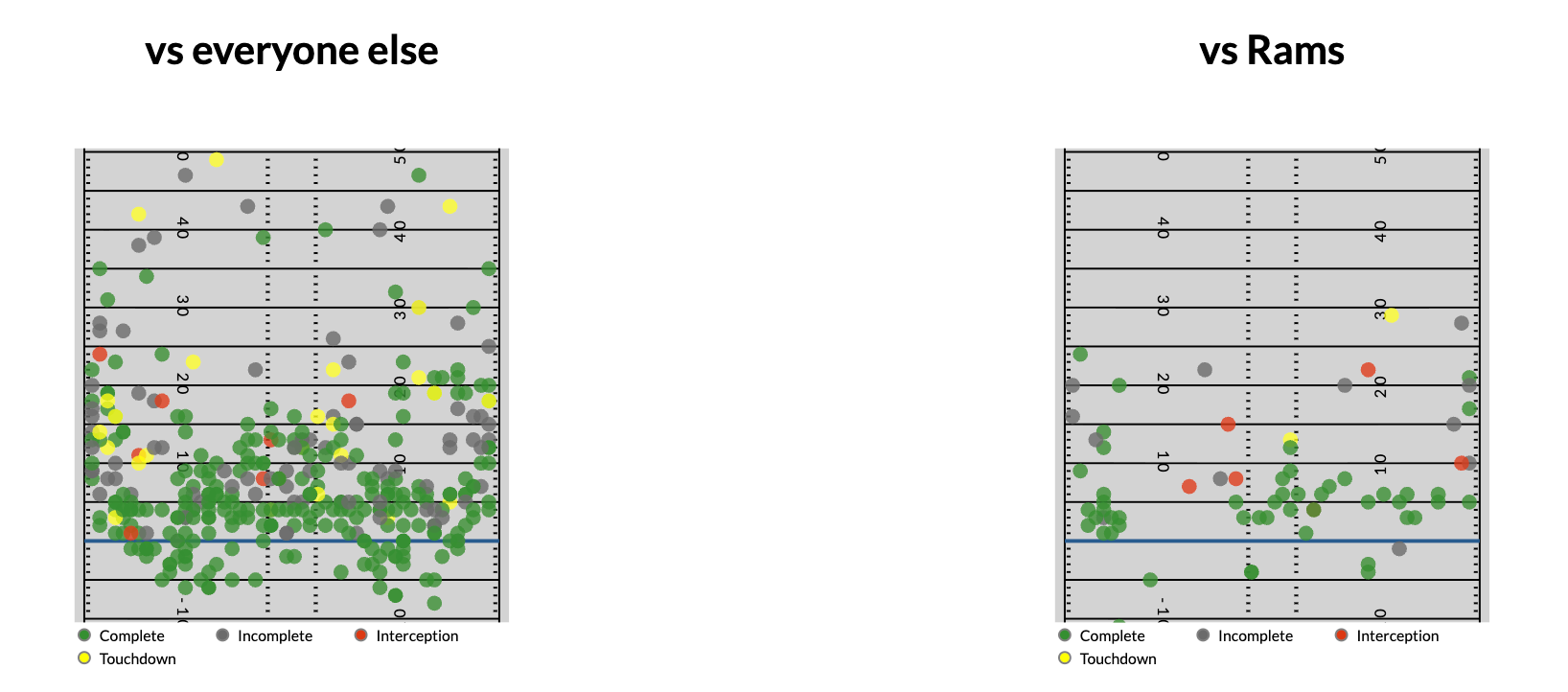
During the regular season, the Rams ran the highest rate of stunts and the fifth-highest rate of simulated pressures. Everything for the Rams has been about changing the picture for Darnold. He’s thrown six interceptions against the Rams and eight against everyone else. Those have gone from giving signs of man and switching to zone, having safeties breaking on balls that were forced downfield under pressure, and dropping Kobie Turner into coverage near the goal line.
Every quarterback is worse under pressure, but Darnold has one of the biggest splits under pressure. When pressured against non-Rams opponents, Darnold averaged -0.30 EPA per play, which would rank 20th among quarterbacks. Against the Rams, that drops to -0.63 EPA per play, which would rank 33rd of 33 passers this season.
Can the Seattle run game find consistency?
One way to settle Darnold down could be staying ahead of the sticks and getting enough support in the run game to not force Darnold into obvious passing situations. That was a big difference in the two games these teams played during the regular season. In Week 11, the Seahawks had a 33.3% success rate on the ground, while that jumped to 47.8% in the Week 16 win. Kenneth Walker had a success rate below 40% in both games, but 18.2% of his rushing attempts went for 10 or more yards. Most importantly, only one of his runs was stopped at or behind the line of scrimmage. During the regular season, 19% of Walker’s runs were stuffed, which was 34th among 48 qualified running backs.
With Zach Charbonnet out, Walker will take the bell-cow role. Including the Divisional Round, Walker has only taken over 60% of the team’s running back carries in a game three times this season.
We could see the Seahawks keep the Rams off balance with some wide receiver runs. Rashid Shaheed had a 31-yard end-around during the fourth quarter in Week 16 and Cooper Kupp is no stranger to a jet sweep.
Do the Rams go 11 or 13 — or does it matter?
The Rams came alive with their shift to more 13 personnel throughout the regular season, but they’ve gone back to 11 personnel during their two playoff games. The Rams were in more 13 against the Panthers, but continued to throw to receivers on the outside despite the middle being the clear weakness of the Carolina defense. Then, against the Bears, with a clear weakness at linebacker, the Rams ran the second-highest rate of 11 personnel in a game all season.
In the regular season meetings against the Seahawks, the Rams had one game with a 64/36 split between 11 and 13 personnel and another with a 35/61 split, respectively. In Week 11, when the Rams were in 11 64% of the time, the Seahawks countered with 60% nickel and 28% dime overall. In the second meeting, with a 61% 13 personnel rate, the Seahawks spent the game in nickel 70% of the time.
Regardless of the personnel, the outcome could come down to how well Puka Nacua gets open.
Here’s Nacua with a short motion from 11 personnel for a deep dig behind Seattle’s linebackers.
Rams were excellent at getting Puka into open space against the Seattle defense
— Dan Pizzuta (@danpizzuta.bsky.social) 2026-01-21T20:46:07.860Z
Then there was Nacua getting matched up with safety Coby Bryant from 13 personnel.
Rams 13 personnel vs nickel — wastes the three tight ends on Seattle's CBs and gets Puka vs a deep Coby Bryant
— Dan Pizzuta (@danpizzuta.bsky.social) 2026-01-21T20:48:45.074Z
In the two games against Seattle, Nacua had 12 receptions for 125 yards from 11 personnel and six catches for 121 yards with two touchdowns from 13. Overall, Nacua had 300 receiving yards in those two meetings. His 4.55 yards per route run in those games were above his league-leading 3.48 average during the season.
Will the Rams’ special teams hold up?
The biggest gap between these two teams comes from special teams. Seattle was second in special teams DVOA, while the Rams ranked 26th. That’s a significant enough difference that it could play a part in this game.
Early in the season, the Rams had their lowest value come from field goals and extra points, where they only hit 78.6% of their field goals, the fifth-lowest rate in the league. Much of that has changed since Harrison Bevins became the kicker, missing just one of his 12 attempts. Even with that cleaned up, there could be concerns.
Seattle had one of the best kick return units in the league, which was aided by the trade for Rashid Shaheed. His play has already helped shape a playoff game with his opening return for a touchdown against the 49ers. But the Rams’ best part of special teams is their kickoff team. They ranked fourth in kickoff value, per FTN. The Rams had the lowest return rate in the league and opted for touchbacks more than 60% of the time. But when the Rams allowed a return, just 6.8% made it past the 35-yard line, the lowest rate in the league.
However, the Rams had one of the league's worst punt units, allowing a league-high 16 yards per return. Shaheed’s 14.7 yards per punt return average was third in the league during the regular season, which included a 58-yard return touchdown against the Rams in Week 16.