Are We Framing Positional Value Correctly?

If there’s one thing that’s been repeated about the 2026 NFL Draft, it’s that the class lacks the top-end talent at premium positions. A quarterback is going first overall and Fernando Mendoza might be the only passer selected in the first round. There are a few edge rushers who will be taken early in the first round, but they might not be the true No. 1 options that would have gone early in previous drafts.
The likely first pass rusher taken, Arvell Reese, has some evaluators believing he’d be better as an off-ball linebacker. Meanwhile, the Wide Left consensus big board features a running back, safety, and linebacker in the top five. At DraftKings, the over/under for safeties selected in the first round is 2.5 with the under at -265, implying 72.6% odds. It’s an uncommon draft class.
That’s brought a lot of conversation around the idea of positional value. We get that every few drafts, when one of the best players in the class plays a perceived non-premium position. This year, we have several. At times, the discussion turns into a blanket “you can’t take a [position] in the [first round/top 10/insert other draft pick here].” It's happened a ton when talking about the top of the upcoming 2026 class. But positional value is not a binary yes/no.
So often this is brought up in terms of market value, basing its importance on how the position is paid on second and third contracts. The most obvious and most talked about example is at quarterback. The top 10 players at the position get paid in excess of $50 million per year as an average annual salary.
As the first overall pick, Fernando Mendoza will sign a four-year/$58.2-million contract. That $14.55 million average over the first four years would make Mendonza the 18th-highest paid quarterback by AAV. Of course, that ranking undersells the raw difference between $14.5 million and a potential $50 million average. That goes for other highly-paid positions, such as tackle and wide receiver. Both the raw value difference and the immediate high ranking among the league’s top earners are used as reasons to avoid taking those other positions early.
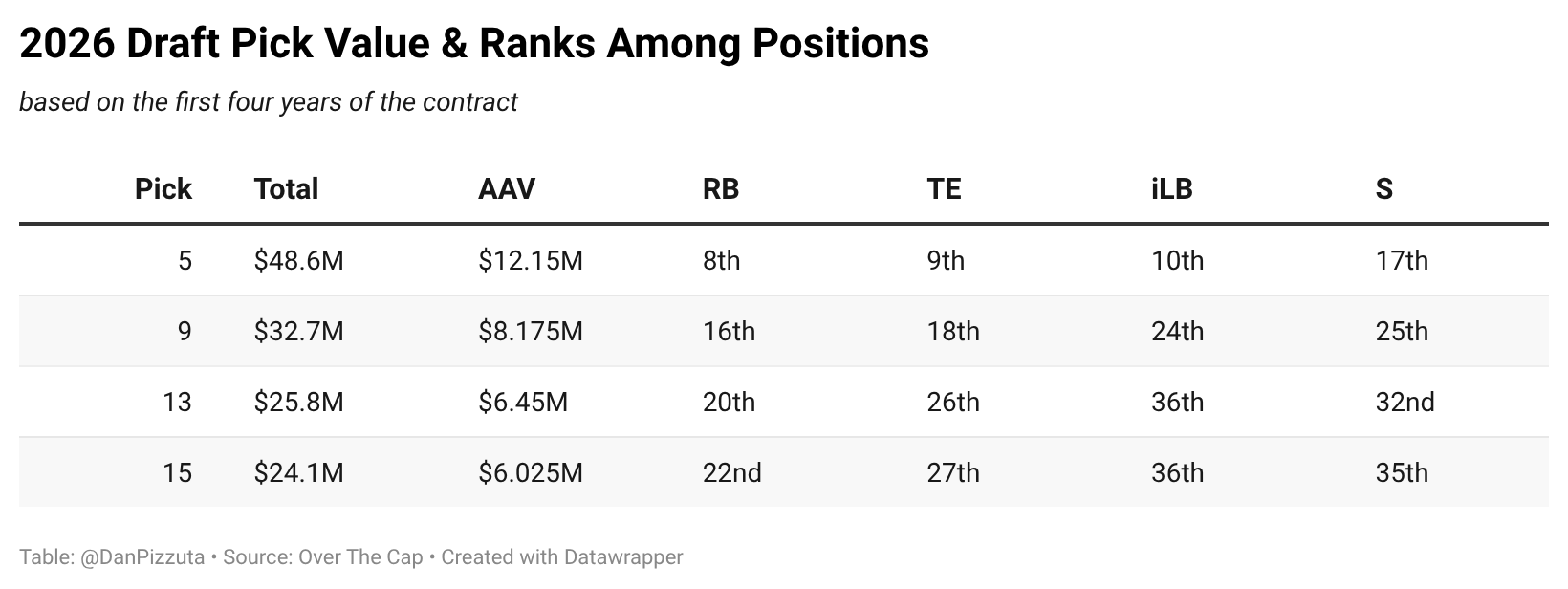
Because there is a fixed contractual value tied to when a player is drafted instead of the position, it creates market dynamics that don’t tend to exist on non-rookie deals. For this draft, here’s where certain position contracts would rank based on when they’re selected, according to the rookie pool figures provided by Over The Cap.
But this way of looking at positional value also assumes an efficiently calibrated market. That’s giving the NFL a ton of credit in pricing these positions correctly, and that’s not always the case. Sometimes, how a market is set is quite silly and often hinges on player movement at the right time.
Let’s take the current wide receiver market and the catalyst to get us to the current state of multiple positions as an example. Back in 2020, DeAndre Hopkins signed a two-year, $54.5 million contract extension with the Arizona Cardinals after being traded from the Houston Texans. At the time of the extension, Hopkins still had three years remaining on his contract, which brought the total value of his deal to five years and $94 million for an $18.8 million average. However, when contracts are discussed and reported around the NFL, it’s all about the new money. So despite the extension not kicking in for another three years after it was signed, the Hopkins deal was considered a $27.5 million average annual salary, easily the top average at receiver, and a massive outlier at the position, the equivalent of 13.7% of the cap when signed.
That $18.8 million average over the full contract was right near the top of the receiver market, which had just reached the $20 million mark with contracts for Amari Cooper and Keenan Allen, at 10.1% of the cap. The Hopkins average was mostly viewed as an outlier, though few quality receivers were up for new deals. Though in 2021, Davante Adams was preparing for a new contract and reports indicated he wanted to be the league’s highest-paid wide receiver, which meant topping Hopkins’s $27.5 million figure. The Packers, at the time, did not view that number as a realistic benchmark, which paved the way for a contract dispute and Adams’s eventual trade to the Las Vegas Raiders in 2022. As part of the trade, Adams signed a contract extension that averaged $28 million per year. But even that number was largely fake, with two inflated non-guaranteed cap hits at the end of the deal. Still, the precedent was set for a new figure on top of the market. Shortly after, in that same offseason, Tyreek Hill was traded to the Miami Dolphins and signed a four-year/$120 million extension to hit a $30 million average. That, too, was inflated by a huge cap hit in the final year of that deal. That last year was supposed to be 2026.
Since then, we’ve seen multiple real contracts at wide receiver beat those figures, and those numbers have been used to increase other positions in the battle to be the top-paid non-quarterback. We now have multiple positions over $30 million per year at the top, with both edge and wide receiver clearing $40 million. (Will Anderson hit $50 million over three years minutes after posting.)
Few NFL teams will willingly go against the status quo of the market without the necessary push. So often, that comes from player movement. That also becomes part of the rationale for picking premium positions because those players don’t tend to become available after their rookie contracts. But as we just went over, the wide receiver market exploded because three of the top players at the position were traded. Micah Parsons is at the top of the edge market after a trade. Trent McDuffie just topped the cornerback market this offseason after a trade, surpassing Sauce Gardner’s post-trade extension.
Safety is a position that is viewed as widely available in the free agent market each season, and while that’s true by volume, the current top five players at the position by AAV all signed extensions with the team that drafted them. Imagine what Kyle Hamilton would be paid if he either hit the open market or forced himself out of Baltimore via trade during a contract dispute. We’d be talking about the safety market much differently. The same could go for Fred Warner, the highest-paid linebacker. What if having Hamilton at $25.1 million or Warner at $21 million per year is a market inefficiency itself?
We also don’t know where some of these markets are going to go from here. Will Tyler Linderbaum’s massive deal with the Raiders as a free agent reset the center market and bring future deals closer in value to the rest of the offensive line? How will the immediate impact of young tight ends such as Brock Bowers, Colston Loveland, Tyler Warren, and Harold Fannin shape the tight end market in the next few years, one that’s woefully lagging behind wide receivers?
Now that also brings us to the on-field value of these players at these positions. This is where we will note the case for a running back continues to fall short. Just last season, Ashton Jeanty was selected sixth overall, but proved how important the infrastructure around the back is for there to be success at the position. The Raiders had one of the league’s worst offensive lines and rarely gave Jeanty room to run. He finished his rookie season 49th of 49 running backs with at least 100 carries in success rate, per TruMedia.
(We’ve also seen top on-field backs like Saquon Barkley and Christian McCaffrey have the chance to significantly alter the market, but that result was a small boost. We’ll keep an eye on what happens with Jahmyr Gibbs and Bijan Robinson.)
That’s not necessarily the case elsewhere on the field. We’re in the middle of a heavy-personnel revolution with offenses leaning more into tight ends. Defenses needed to find the best way to counter. While the rate of base defense jumped against multi-tight end sets in 2025, the league’s best defenses were some of the smallest by snap-weighted size. Some of the league’s best defensive units featured a defensive back who could play the role of a linebacker against bigger personnel or linebackers who could move and cover like defensive backs. That archetype of player is becoming increasingly valuable on the field — both Sonny Styles and Caleb Downs would qualify. In the modern game, we’ve already seen players at these positions be able to transform what a defense can do.
There’s an argument that the surplus value for the players at these positions comes from what they’re providing on the field instead of what they could cost compared to the top of the market. That matters, too. It could also continue to be a value as they move on to their next contracts.
It shouldn’t take having to frame Downs or Styles as unicorn prospects and needing to become among the best players at their positions to view them as worthy early picks. But it also wouldn’t be surprising if we look back and view them as the most valuable players to come out of this class, whether the numbers on their next contract say that or not.