Contextualizing Wide Receiver Production For The 2026 NFL Draft Class

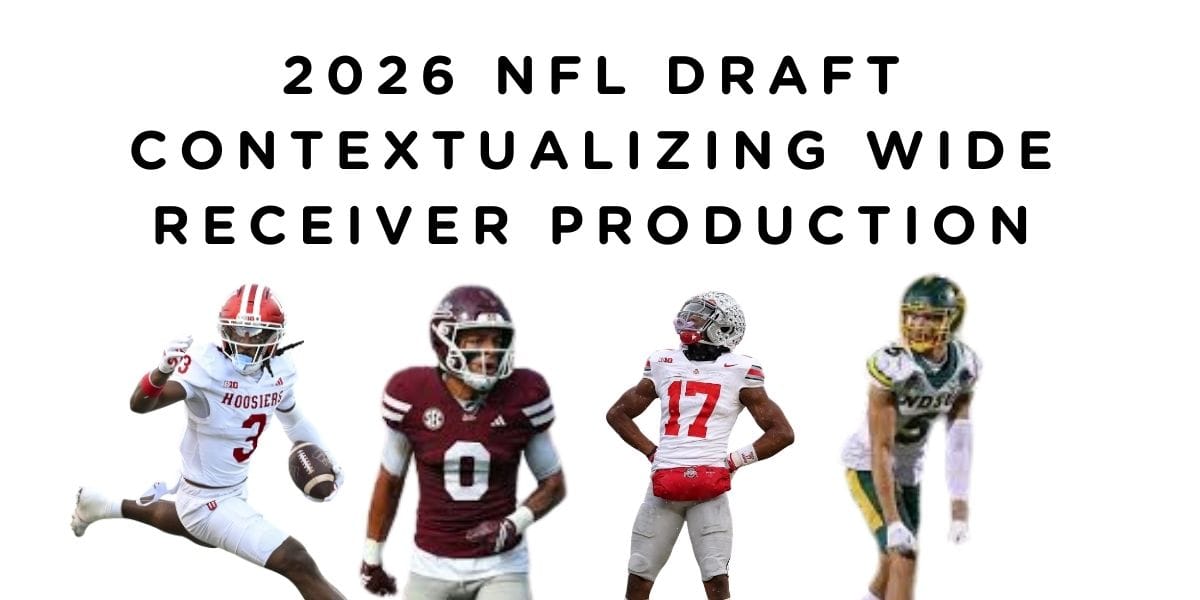
Few positions are more fun to watch and talk about for draft analysis than wide receiver. With so many good receivers coming into the NFL over the past few seasons, it's made analysis even more fun. One of the reasons is the wide variety of skill sets and body types that can work at the position. It's also become one of the most valuable positions in the league, both by salary and how rare it has become for a good one to become available as a free agent. Getting a good receiver through the draft is the best bet.
Figuring out who those are and how they can do it is the hard part. Given how different offenses and roles can be across college football, there’s no easy way to compare what these players were asked to do.
A way to help differentiate those offenses is a metric I’ve called "Target Yards Added." Simply, Target Yards Added takes a wide receiver’s yards per target and subtracts yards per attempt when the quarterback throws to anyone else on offense. That way, we get a bit of a baseline of what the overall production was and what a given receiver adds to it. College offenses are weird and it can be useful to understand that when analyzing receiver prospects. These numbers are all based on the receiver’s final college season.
This metric is not meant as a proxy for receiver rankings, but it can provide some more context on how these receivers performed and on their surroundings. Let's take a look at this year's numbers before we dive deeper into what they mean.
Top of the Class
The sweet spot of this analysis is when the receivers who are considered the best prospects in the class also show up as the ones who added the most to their offenses. This is what we have this season with Ohio State’s Carnell Tate. Tate, who came in at 6-foot-2 and 196 pounds in Indianapolis, is widely, though not unanimously, viewed as the top receiver in this class.
Tate is a smooth athlete who can use his frame to box out defenders and win on contested catches:
Big boy WR play from Carnell Tate right here.
— Matt Harmon (@MattHarmon_BYB) January 16, 2026
(yes I have begun charting prospects) pic.twitter.com/GdqsxeaOuz
He can also separate to win deep down the field.
The Chiefs could *really* use Carnell Tate. It's time to grow up at that position. He is plenty fast enough btw.
— Hayden Winks (@HaydenWinks) February 2, 2026
Surprising if he's not in the fringe top-10 range. pic.twitter.com/Q5zH3NxOpH
(sidenote: apologies for Twitter embeds. They’re unfortunately the best way to go about these types of clips. NFL Draft Bluesky needs to pick it up.)
Tate only ran an official 4.54 forty at the combine, but that shouldn’t impact any analysis of his game (or any receiver’s, really, which we’ll get to). He’s a smooth enough strider and route-runner that he doesn’t need track-star speed to pull away from defensive backs.
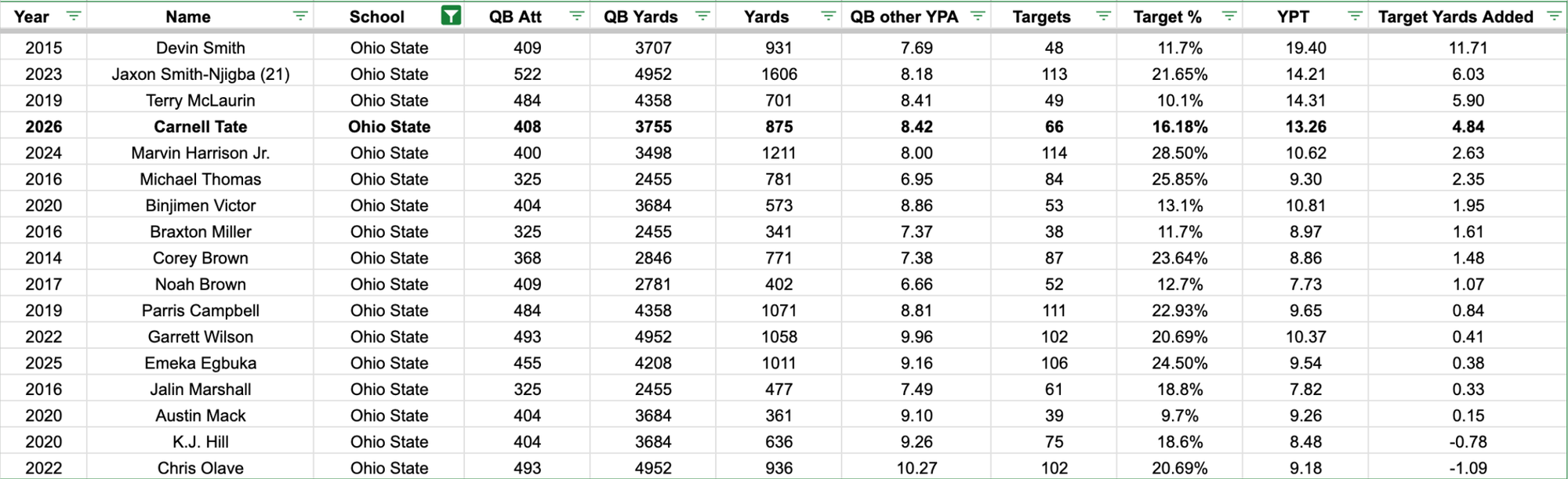
During his final season at Ohio State, Tate added 4.84 yards per target for the offense. His per-route efficiency was impressive (his 3.17 yards per route run ranked fourth in this class), though he didn’t have the high volume typically seen from a No. 1 receiver with just a 16.2% target share, though that includes his three games missed at the end of the season. In games he played, Tate had a 21.9% target share in games he played. However, that would still rank just 18th in this draft class.
Getting production out of a smaller target share is noteworthy, especially in an Ohio State offense that Target Yards Added has admittedly struggled to grasp Buckeyes, typically because of how deep those receiving corps are. Both Garrett Wilson and Emeka Egbuka stand out as successes despite sub-1.0 Target Yards Added. Chris Olave is the lone receiver in the entire database to break through with a negative number in his final college season.
The FCS Star
Another way this metric can be helpful is to find value in some of the mid-tier receivers who come out on top. We’ve also had a good recent look at FCS receivers who clearly outperformed their surroundings. Enter Bryce Lance, brother of Trey, from North Dakota State. Lance leads this class in Target Yards Added and has metrics similar to those of other FCS receivers, Christian Watson and Jalen Coker.

Watson got more volume, but Lance was an even bigger big-play threat. Last season, 27.4% of Lance’s plays went for 20 or more yards, which ranked third among all combined FBS and FCS receivers with at least 50 targets. Lance has a long frame with speed to win on the outside and down the field.
North Dakota State WR Bryce Lance's outstanding 10/40 speed is definitely a thing on the field, and what I love about him at 6-foot-3 and 204 pounds is the sudden next-level acceleration in short spaces. Boom, he's gone. pic.twitter.com/7uNhTGl8kL
— Doug Farrar ✍ (@NFL_DougFarrar) March 1, 2026
There might be some concerns about the route tree, given how vertical Lance’s role was in the North Dakota State offense. Last season, 32.4% of Lance’s routes were go routes, second to Emmanuel Henderson of Kansas in this class, with no other receiver over 30%. Hitches made up another 23.2% of his routes, marking over half of his routes between those two. Still, Lance is a big enough threat on those deep passes to add credible juice on the outside that can allow him to take advantage of those downfield shots while he develops into a more well-rounded receiver.
Lance entered the combine week ranked 99th on Dane Brugler’s top 100. Adjusting too much for his massive testing numbers at the combine could be double-counting some of the athleticism that was already clear in his game. But Lance turning into an earlier Day 2 pick — a la Watson — would not be a surprise.
Lifting bad offenses
Let’s take a look at the five receivers whose offenses averaged the lowest yards per attempt when the quarterback threw to anyone else on the offense.

Making the most of a bad offense doesn’t automatically make someone a good receiver, but we can see that the degree of difficulty was much bigger for those in this part of the list, as opposed to some others. Three of the five stick out.
Chris Bell was a big part of the Louisville offense, but suffered a torn ACL in December. At the combine, he told the media he’s three months out from surgery and would start running shortly after with a potential recovery by training camp. Bell had four different quarterbacks during his four years at Louisville and produced each season. His 27.2% target share for 2025 was fourth in this class.
9/136/2 last night for Louisville WR Chris Bell.
— Dane Brugler (@dpbrugler) October 18, 2025
AJ Brown-like acceleration at 227-pounds! pic.twitter.com/JZix78FjuC
Kevin Coleman from Missouri is a twitchy, smaller slot player who carried the Tigers offense with a lower aDOT with yards after the catch ability. No receiver in this draft class ran more crossers (22% of routes) than Coleman. But on crossers, he averaged 3.93 yards per route run with 7.3 yards after the catch per reception. He can also find space when given the opportunity in the open field.
Kevin Coleman, Jr. #Mizzou #NFLDraft
— Matt Waldman (@MattWaldman) January 9, 2026
More open-field goodness after catching the target up the seam.
Processes defender angles fast and his footwork is precise. pic.twitter.com/KAxwChOaMZ
Then there is Ted Hurst of Georgia State. Hurst ran a 4.42 in Indianapolis at 6-foot-4 and 206 pounds. Hurst is a big-play machine with his size and speed. He can high-point the ball in contested or adjusting situations and can break away from defenders in the open field. Georgia State spammed Hurst on slants, using his frame and speed on a draft-class-high 13.7% of his routes.
#GeorgiaState WR Ted Hurst (#1) hitting the R2 button at 6'3, 207 pic.twitter.com/q3ofUpE2Hk
— JP Acosta (@acosta32_jp) February 11, 2026
The Indiana Problem
It’s not always the case, but occasionally this metric has a tough time gauging multiple receivers from great offenses. As mentioned above, that’s historically been contained to Ohio State. But this year, we seem to have that issue with Indiana. Bryce Lance was in the offense that had the highest yards per attempt to other players (another layer of how good his season was to stand out within that), but Elijah Sarratt was second and Omar Cooper Jr. was fourth.
Nearly half of Indiana’s passes went to Cooper and Sarratt for good reason. Cooper was the shiftier slot receiver and Sarratt used his size to win on the outside. Both were touchdown magnets.
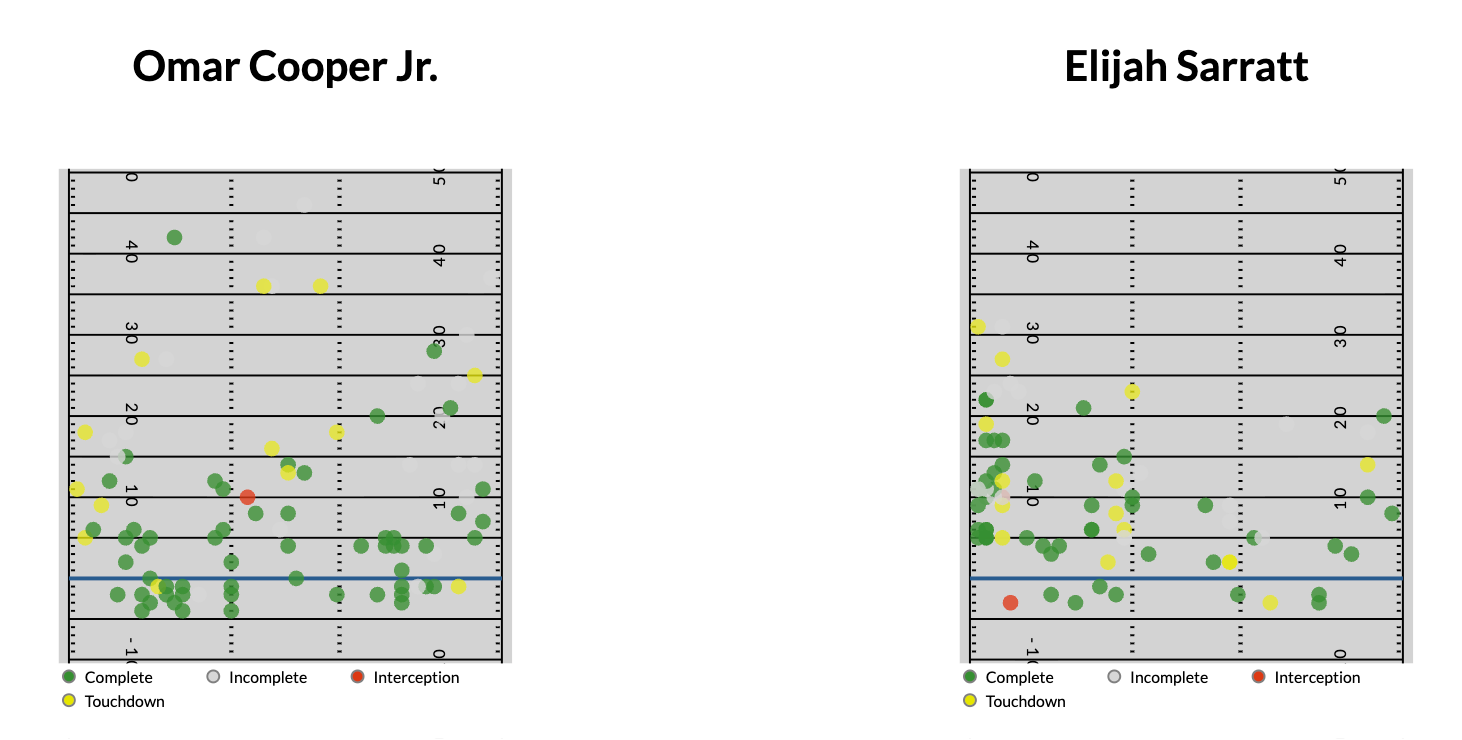
Cooper Jr. is considered a fringe-first-round prospect while Sarratt is viewed as a Day 2 receiver. Both played a big part in why the Indiana offense was so good, and a lower rank on this metric should not be reason enough to write them off.
Going Fast
Everyone loves speed, but it needs to have a purpose — especially at receiver. One of the biggest red flags is when a prospect runs super fast but didn’t add to his college offense when speed on its own is a much bigger differentiator. Receivers at the NFL level need more nuance in their movement than just straight-line speed. Over the past few seasons, we’ve seen players like Xavier Worthy (0.00 Target Yards Added) and AD Mitchell (-1.89) struggle to become consistently productive wide receivers despite blazing speed. Mecole Hardman (0.12) was in the same category and we can go all the way back to John Ross (0.05) for another comp.
Luckily, we don’t have too many players that fall into this bucket this season. Among the fastest receivers in Indianapolis, Cincinnati’s Jeff Caldwell and Oklahoma’s Deion Burks come the closest. However, Caldwell is still a project at receiver and was viewed as a UDFA heading into the combine and might have made his way into Day 3 consideration because of his athletic profile. That’s much different than a speed-only high pick. Burks would likely be drafted with a slot/gadget role in mind.
Where speed does play is with Mississippi State receiver Brenen Thompson. Thompson measured in at 5-foot-9 and 164 pounds at the Combine. Despite that size, Thompson lined up outside on 86.3% of the time. He also had an aDOT of 18.37, a yard and a half above the next receiver in this class. He also had a class-lead 44.2% of his team’s completed air yards.
My expectations for a 5'9"/170 WR who run 4.2s was not that he'd play on the outside on 86% of his snaps and only have 4 receptions on screens.
— Hayden Winks (@HaydenWinks) February 25, 2026
Brenen Thompson earned all 1,054 yards vs. a SEC schedule. pic.twitter.com/6YgMHt8HpR
Other notes
- I will get hurt by a Tennessee receiver again, but Chris Brazzell has a more rounded-out game than last year’s Target Yards Added leader, Dont’e Thornton.
- Malik Benson could be a fun dart throw as an explosive option (25% rate of 20 or more yards), who couldn’t break through an Oregon offense that often spread the ball around.
- Denzel Boston and Jordyn Tyson both fall into a danger area under 1.0 Target Yards Added. Red flags don’t come up until the number is negative, but it gives more of a case for Tate as the No. 1 receiver in this class.
- This isn’t the be-all and end-all of receiver analysis, just a tool in putting together the profiles of these players.