The Watchlist Super Bowl LX: What To Watch When Each Team Has The Ball

On Sunday, we get the Seattle Seahawks and the New England Patriots in Super Bowl LX. While this may seem unexpected based on preseason projections (both teams had a win total set at 8.5), we have a meeting between the two best teams at this point in the season. The Seahawks and Patriots are the top two teams by weighted DVOA. Seattle has gotten here by being the best team in the league throughout the season and one of the best teams ever tracked by DVOA. New England rode a breakout season from Drake Maye and one of the league's most efficient offenses through the regular season, while the defense has peaked throughout the playoffs.
That gives us so many fascinating matchups in this game. Here we'll take a look at the matchups that could be key on each side of the ball.
When The Seahawks Have The Ball
Sam Darnold vs Pressure
Darnold just came off one of his best games of the season in the NFC Championship Game against the Los Angeles Rams, but that most recent performance has overshadowed how he has played for most of the year. There have been highs, sure, but there aren’t trust needles built for quarterbacks who are consistently playing at the top of their games.
As has been the case throughout his career, Darnold is still one of the most susceptible quarterbacks when pressured. When kept clean, Darnold was ninth among quarterbacks in EPA per play. When pressured, that dropped to 24th. Per FTN, Darnold’s turnover-worthy throw rate jumps from 2.7% when not pressured to 5.7% when pressure arrives. It’s not just that Darnold decides to put the ball into danger; the pressure changes how Darnold processes and where the ball goes. Darnold extends plays outside the pocket more often and his throws targeting wide receivers drop significantly.
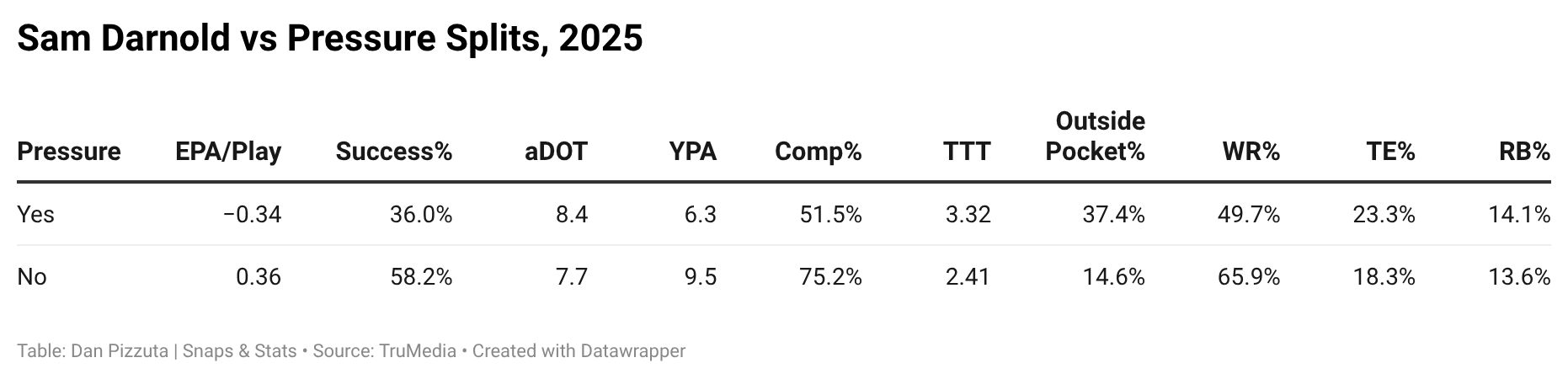
So far in the playoffs, Darnold has been pressured on 40.7% of his dropbacks. That could play into the Patriots’ hands. During the playoffs, the Patriots have 51.9% pressure rate. The best team in the regular season had a pressure rate of 44.9%. Interior pressure could also be a key here. Between the regular season and playoffs when both Milton Williams and Christian Barmore are on the field, the Patriots had 44.8% pressure rate. The interior of the Seahawks’ offensive line is the weakness, namely Anthony Bradford. Bradford ranked 28th in blown block rate among right guards with at least 400 snaps, according to Sports Info Solutions.
Per Next Gen Stats, Williams has six quick pressures so far in the playoffs. No other interior lineman has more than two.
New England has gotten to the passer by blitzing nearly 40% of the time in the playoffs, a jump from a 27% blitz rate during the regular season. Including the playoffs, Darnold has been good against the blitz, but that comes with a huge pressure split. When blitzed but not pressured, Darnold has a 60% success rate. When pressure gets home with a blitz, that drops to 37.3%.
The Patriots also had the second-highest stunt rate in the league during the regular season, according to MatchQuarters. The Rams were first and they were able to use some of those stunts to get free rushers and mess with Darnold.
Messing with Darnold doesn’t guarantee a New England victory — Seattle was a league-best 7-2 when the offense threw at least one interception with a plus-109 point differential that is the equivalent of the sixth-best team overall during the regular season — but forcing Darnold into making bad decisions under pressure is the best pathway for the Patriots and it’s one place where the strength meets a clear weakness on that side of the ball.
Can Jaxon Smith-Njigba Be Stopped?
Jaxon Smith-Njigba might be the best offensive player in this game, which includes an MVP runner-up. For the first half of the season, Smith-Njigba was on pace to shatter the single-season receiving record before his raw production slowed with the rest of Seattle’s offense. Still, Smith-Njigba was second among all receivers in yards per route run behind Puka Nacua and led the league in target share at 35.9%. The only player with a higher target share since 2010 is 2012 Brandon Marshall, who had a 40.1% target share in 2012. We’ve never seen a team get to a Super Bowl with such a focus on one receiver in the modern passing-boom era of the NFL.
That raises the question — how do the Patriots defend Smith-Njigba? There’s the old Bill Belichick philosophy of double-covering an opponent’s top receiver, in this case, 1-double-11. That’s typically man coverage that puts the No. 2 cornerback on the opposing No. 1 receiver with a safety over the top while the best corner takes the opposing No. 2 receiver on his own. But that doesn’t feel like the right play here for a few reasons. The Seahawks don’t really have a No. 2 outside corner, which would essentially waste Christian Gonzalez in coverage. Seattle’s No. 2 and 3 receivers are Cooper Kupp, who lines up in the slot, and tight end A.J. Barner. Rashid Shaheed is a deep threat on the outside, but isn’t a high-volume target and the Patriots could be wasting Gonzalez by matching him up there and then hoping he can keep up with Shaheed’s speed.
The Patriots aren’t a super-heavy man coverage team. They’ve played just under 30% man coverage in both the regular season and playoffs, which is the ninth-most in the league. However, Gonzalez did cover opposing No. 1 receivers 40% of the time during the regular season, according to FTN. That also leaves a bit of a disconnect between Gonzalez’s ability and some of the results. Gonzalez ranked 32nd among cornerbacks in adjusted yards allowed per coverage snap (a group that includes 138 players with at least 100 coverage snaps on the season). Still, the Patriots ranked 31st in DVOA against opposing No. 1 receivers, though they also averaged the second-fewest passes per game to opposing No. 1 receivers.
Seattle has done an excellent job of moving Smith-Njigba around so not all opposing defenses can zero in on one strategy to stop the receiver, especially in the playoffs. After lining up outside for more than 80% of his snaps in the regular season, Smith-Njigba has lined up outside for just under two-thirds of his snaps in the playoffs, increasing his time spent in the slot and the backfield.
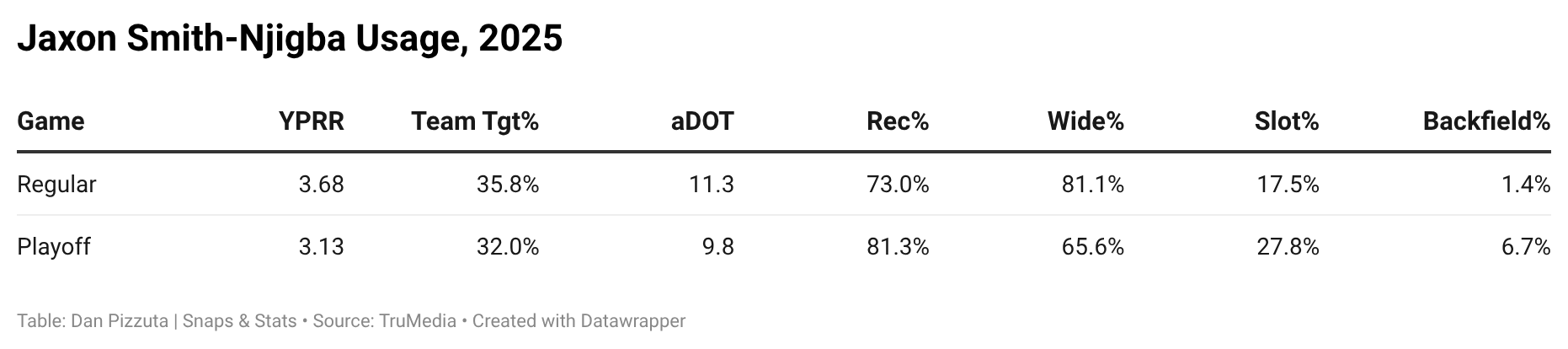
If the Patriots can slow Smith-Njigba down on the outside, expect him to move more into the slot. His usage in the backfield opened up a free touchdown against the Rams in the NFC Championship Game.
Even if the Patriots trust Gonzalez to cover Smith-Njigba on his own, we might not get many snaps where that is a true matchup.
Can The Seahawks Run The Ball?
Over the course of the season, the Seahawks have been one of the run-heaviest teams in the league on early downs. Including the playoffs, Seattle has a 46% early-down pass rate, which is higher than only the Commaners and Ravens — two teams with a heavy quarterback involvement in the run game. Seattle was 21st in success rate on running back carries and 19th on early downs. Much of the success came from Zach Charbonnet, who suffered a season-ending injury in the Divisional Round.
Kenneth Walker took a season-high 86% of the Seahawks’ carries, but only had a 26.3% success rate while he averaged 3.3 yards per carry. He was stopped at or behind the line of scrimmage on 26.3% of his runs, with just 5.3% gaining 10 or more yards. Walker has been a bit of a boom-or-bust runner throughout his career. This season, he was 30th in the rate of runs that were stuffed, but third in the rate of runs that gained 10 or more yards. He can also do things like this:
Kenneth Walker scored a touchdown here
— Dan Pizzuta (@danpizzuta.bsky.social) 2026-01-26T14:23:37.706Z
The Patriots have one of the league’s best run defenses. On early down running back carries, the Patriots have the sixth-highest success rate and allow the second-lowest yards per carry with the fourth-best stuff rate. That’s not just from the interior. New England’s edges and second-level defenders have been solid in defending the run. The Patriots ranked seventh during the regular season in second-level yards, per FTN.
The Kubiak run game has evolved and become more diverse than the outside zone-heavy scheme it used to be, but the Seahawks still run outside zone as their most common run concept, according to FTN, on 30% of their runs. New England only faced outside zone on 19% of runs between the regular season and playoffs, but the Patriots’ 3.6 yards allowed against outside zone is the fourth-lowest.
On early-down runs against 12 personnel, the Patriots were just 26th in success rate and had the fourth-lowest stuff rate in the league. Seattle used 12 personnel on 34% of early-down plays between the regular season and the playoffs, the eighth-highest rate in the league. The Seahawks had the fifth-lowest rate of 11 personnel on first and second down. Opponents matched Seattle’s 12 personnel with base 77% of the time, but New England went 47% nickel against those plays.
Getting more efficient early-down runs could stop the Seahawks from getting into third and long. On third-and-7 or more, the Seahawks were 26th in EPA per play.
Seahawks on Play-action
Early-down efficiency also goes into the play-action game, where the Seattle offense thrives. The Seahawks were seventh in play-action rate and Darnold ranked fourth in EPA per play on play-action. When Seattle uses play-action, it gives Darnold time to get out of the pocket (48.8% of his plays end outside the pocket off play-action) and those boots are a way to settle down a pass rush, especially from the interior. With more time away from the rush, Darnold also throws the ball further down the field. Without play-action, Darnold has averaged a 7.1-yard aDOT and 7.5 yards per attempt. With play-action, those jump to a 9.9-yard aDOT and 11 yards per attempt.
Not only does play-action open up shots down the field (41.6% of his pass attempts travel 11 or more air yards), it gives Darnold more answers in the flat in case those downfield routes don’t open up. If it’s open down the field, rip it. If not, check it down. That mostly eliminates the potential of Darnold putting the ball in danger, though his 3% turnover-worthy play rate was still among the highest for quarterbacks off play-action.
A league-leading 19.6% of Seattle’s play-action plays went for 20 or more yards. New England still had the eighth-lowest rate of 20-plus-yard plays off play-action, but the 8.7% is nearly double the Patriots’ overall rate.
On play-action throws, Darnold has thrown into a tight window on just 8.1% of his attempts, per Next Gen Stats. A key to receivers getting so open is how often the Seahawks use crossing routes. On non-play-action passes, Darnold throws crossers 4.3% of the time. On play-action, that rate rises to 22%.
The Seahawks get those crossing routes going to different depths, such as this deep crosser to Smith-Njigba…
…and this shallow crosser to Cooper Kupp.
The Patriots were first in EPA per play against crossing routes off play-action, including the playoffs. A lot of New England’s defensive value against play-action comes from turnovers, which include three against the Houston Texans in the Divisional Round.
Seattle could find an advantage by going big and running play-action out of 12 personnel, especially if the Seahawks force the Patriots to stay in base personnel. New England only saw 46 play-action snaps out of 12 personnel in the regular season, but were much better defending it with five defensive backs on the field (52.6% success rate) compared to four (47.3%). Out of 12, the Seahawks average 0.64 EPA per play with a 60% success rate. When that comes against base personnel, it’s 1.05 EPA per play with a 66.7% success rate. New England’s base, though, is more about adding another defensive lineman than another linebacker. We’re long past the idea of having to establish the run for play-action to work, but making the Patriots respect the run enough to set those five-man fronts to get the advantageous looks for play-action could matter in this game.
Big Kickoff Returns
Rashid Shaheed can be a game-changer as a kick returner. We’ve seen it twice since he’s been traded to Seattle, including the opening kick return for a touchdown against the 49ers in the Divisional Round. Seattle has returned 34.7% of kicks beyond the touchback line at the 35-yard line, which is the second-best rate in the league.
New England has allowed 21.5% of returns to get beyond the 35-yard line, which ranks 19th. The Patriots have allowed 71.6% of kicks to be returned, which is the eighth-lowest rate in the league, though they are ninth overall in yards per kick return allowed.
When The Patriots Have The Ball
Can the Patriots create explosives?
This is going to be a game of explosives on both sides of the ball, featuring the two offenses that were the best in the regular season at creating big plays, but no team needs those big gains more than the Patriots. When the Patriots had a drive with at least one explosive play (considered a pass of 16 or more yards or a rush of 12 or more), they ranked fourth in points per drive (4.21). On drives without an explosive play, they ranked 32nd (0.47). Including the playoffs, the Patriots nearly split their 212 offensive drives with at least one explosive (107) and drives without one (105). No team had a bigger gap between points per drive with and without an explosive play than the Patriots at 3.74.
Including the playoffs, the Seahawks have allowed a 7.9% explosive play rate, which would be the equivalent of the regular-season Titans, who ranked 32nd among all offenses.
Much of Drake Maye’s production came on deep passes. On throws of 20 or more air yards during the regular season, Maye had a 50% completion rate with a league-leading 1,093 passing yards. He had the fifth-most attempts of 20 or more air yards and led the league in EPA per play on those throws, a rare mix of volume and efficiency. Including the playoffs, the Seahawks have allowed 35% of throws of 20 or more air yards to be completed against them, which is about league-average. On deep throws outside the numbers, that jumps to 42.6%, which is a little worse than average. Maye has completed 54.3% of his deep passes outside the numbers for 1.26 EPA per play.
Maye can also create big plays with his legs. Through the playoffs, Maye has 71 scrambles for 554 yards, both league-highs. He gained 10 or more yards on 25.4% of his scrambles. While man coverage typically leads to more scrambles, Maye had a slightly higher scramble rate against zone (10.1%) than against man (9.7%).
Seattle plays mostly zone coverage, but those coverages act like man with how much matching is done in coverage. Because the Seahawks use everyone in coverage, they don’t tend to spy mobile quarterbacks and they haven’t played many mobile quarterbacks. But the Seahawks came out as one of the worst defenses against quarterback runs. Seattle was 24th in success rate against designed quarterback runs and scrambles and last in EPA per play, including the playoffs.
Will the offensive line hold up?
We talked about how pressure can impact Darnold, but no quarterback throughout the playoffs has been more vulnerable to pressure than Maye. Maye isn’t as likely to put the ball in danger when pressured (though fumbles have been an issue on this playoff run), but he’s more likely to take a sack. During the regular season, Maye ranked 25th in pressure-to-sack rate. Those sacks didn’t always derail the offense. Maye was seventh in EPA lost per sack and lost the fewest yards per play on sacks in the regular season. That hasn’t been the case in the playoffs, though, when Maye has taken a sack on 45.5% of pressures. The highest rate among qualified quarterbacks in the regular season was Geno Smith at 26.2%.
However, Maye has only been pressured on 32.7% of his dropbacks in the playoffs, which is lower than his regular-season rate of 37.9%. When Maye was pressured during the regular season, he was second among quarterbacks in EPA per play (-0.09), but that dropped to -0.65 EPA per play with a 30.3% success rate in the playoffs.
Maye has been more impacted by a four-man rush than against five. When pressured with five pass rushers, Maye still averaged positive EPA per play. But when pressured with a four-man rush, that dropped to -0.15. Seattle had one of the lowest blitz rates during the regular season and has only blitzed on 12% of opposing dropbacks in the playoffs.
The Seahawks have a deep rotation of edge rushers who can get to the quarterback. Boye Mafe (eighth) and DeMarcus Lawrence (15th) were among the best edge rushers at pass rush win rate during the regular season. Lawrence has a quarterback hit on 8% of his postseason pass rushes and has two strip sacks with a third forced fumble on a Kyle Juszczyk carry.
Rookie left tackle Will Campbell has been inconsistent in the playoffs and has allowed quick pressure around the edge. In the regular season, Campbell allowed a 5.8% pressure rate and that has nearly doubled to 10.8% in the playoffs. Campbell missed time with a knee injury late in the season and, upon his return, has faced some of the league’s best pass rushes in the playoffs, including the Chargers, Texans, and Broncos. Things do not get much easier with the Seahawks. Even on plays when Campbell held up relatively well, coverage forcing Maye to hold the ball and drop back deeper into the pocket gave pass rushers a better angle to get around the tackle and sack the quarterback. The Seahawks were 16th in average time to sack on defense, a mix of getting to the quarterback quickly and forcing coverage sacks — both likely to be in play during this game.
Could This Be A Hunter Henry Game?
If there’s a weakness in Seattle’s coverage, it comes against tight ends. During the regular season, the Seahawks ranked first in DVOA against No. 1 receivers, sixth against No. 2s, 13th against No. 3s, and 16th against tight ends. Including the playoffs, Seattle is second in EPA per play against wide receiver targets and 24th against tight ends. If given the option, teams should want to stay away from Seattle’s cornerbacks, who have been fantastic all season long.

While Seattle’s secondary is filled with monsters, the linebackers can be exposed in coverage, especially when they’re so focused on playing downhill. Ernest Jones is everywhere for this defense, but was 46th in yards allowed per coverage snap among linebackers during the regular season. The short middle of the field is where the Seahawks have had trouble against tight ends and you can see how the sidelines are much better defending against wide receiver targets.
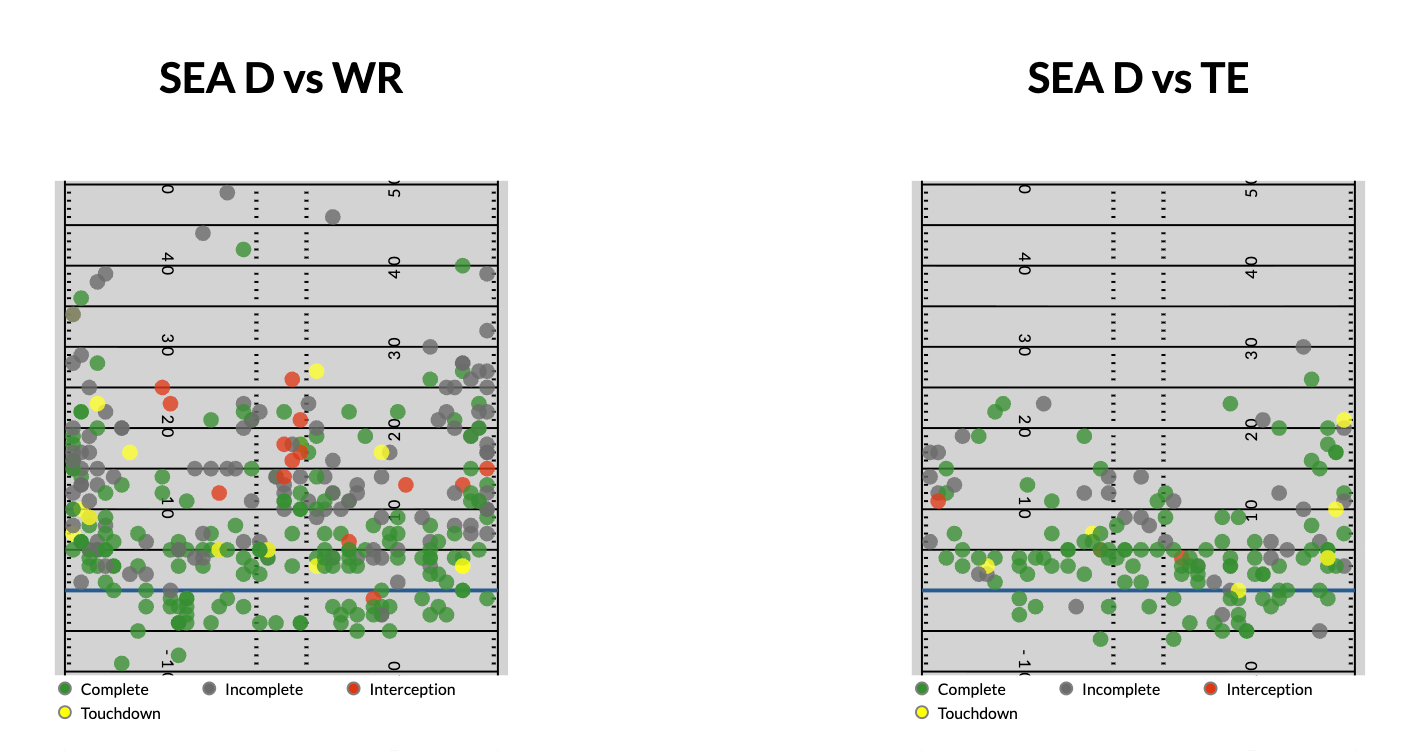
The Seahawks have allowed a higher explosive play rate to tight end targets (17.1%) than to wide receivers (13.1%) and 11.4% of targets to tight ends have gained 20 or more yards. The Seahawks are also worse against tight ends who line up in the slot, which Henry does on about a third of his snaps.

Henry has 12 receptions of 20 or more yards between the regular season and playoffs, which is third among tight ends. He had a 28-yard touchdown against the Chargers in the wild-card game that could look like something the Patriots try against the Seahawks. Henry motioned across the formation and into the slot. He then snuck past the second level and was open on a corner.
When pressured, Henry becomes a more reliable target for Maye. There is less than a 1% target share difference between Henry and Stefon Diggs when Maye is pressured, while Diggs has a 22.1% to 17% advantage when Maye is not pressured.
Will The Patriots Use Heavy Personnel?
The Seahawks don’t play with four defensive backs on the field — they’ve done so at a league-low rate of 6.7% as the only team below 10% this season. Instead, Seattle plays nickel on 75% of snaps. The key to the Seahawks doing this is rookie Nick Emmanwori, the 6-foot-3, 220-pound safety, who can play all over the field. When Seattle is in nickel, Emmanwori is typically the slot corner. He then plays more of a linebacker role when the Seahawks go into dime.
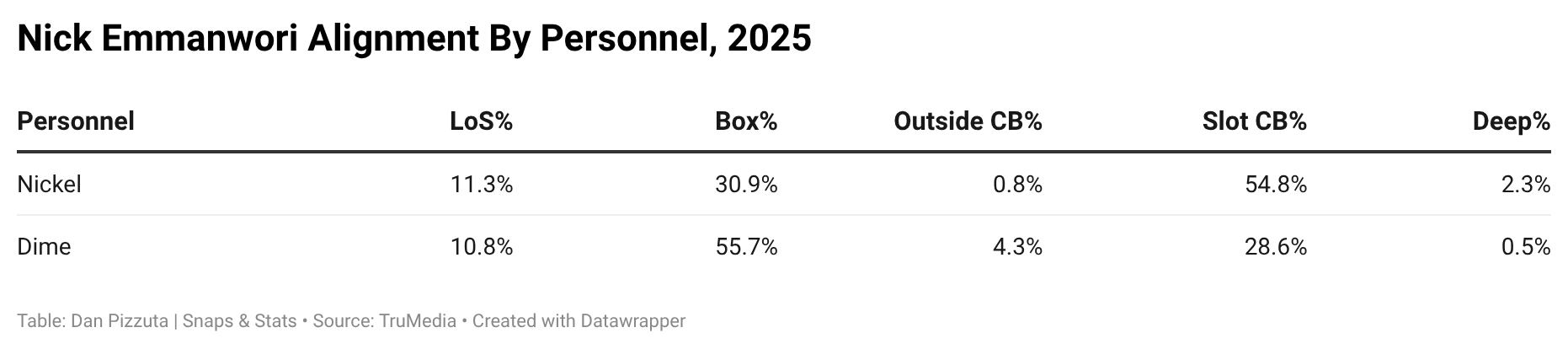
Emmanwori’s range and versatility open up so many things for the Seahawks on defense.
Nick Emmanwori breaking on passes
— Dan Pizzuta (@danpizzuta.bsky.social) 2026-01-26T15:28:20.019Z
Because of how fluid Seattle’s defense can be on the back-end, it’s hard to get a matchup where the Seahawks are at a personnel disadvantage. They’re happy to match their defensive backs against heavier personnel without the fear of being the less physical unit.
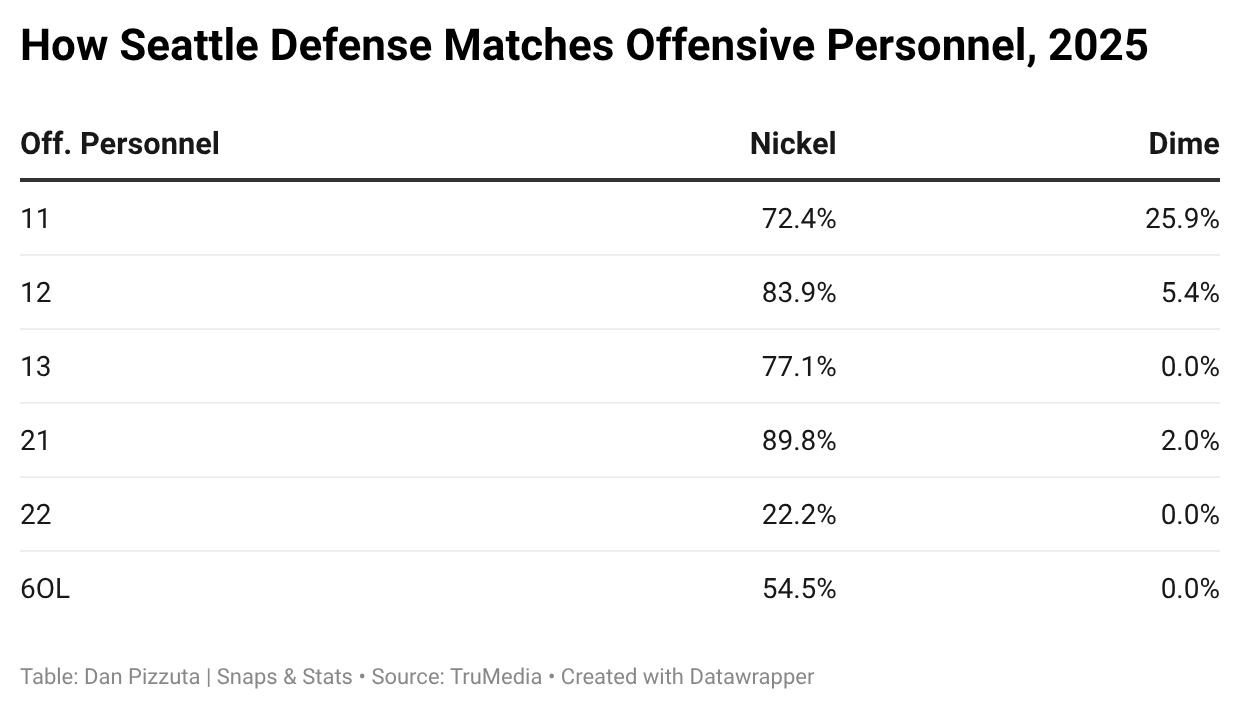
One area where the Patriots might be able to force the issue is with two-back sets. New England uses fullback Jack Westover on about 22% of its offensive snaps. The Patriots use 21 personnel on 14.6% of plays, which is the fifth-highest rate in the league. The Seahawks still play nickel to that almost exclusively. But, the Patriots used 22 personnel on 8.6% of plays, which was the fourth-highest rate in the league and it’s the one personnel grouping where the Seahawks have not countered in nickel. However, the Seahawks only saw 18 plays in 22 personnel and allowed 1.9 yards per play.
A changeup the Patriots have gone to at times during the season is Pony personnel with both TreyVeon Henderson and Rhamondre Stevenson on the field at the same time. Pony personnel can often be better in theory than in practice, but the Patriots have some positive plays throughout the year with both running backs on the field. Typically, the biggest hangup with Pony personnel is the lack of a downfield passing game — it condenses the offense. But that hasn’t been an issue with the Patriots.
Here’s a play in Week 5 against the Bills when both backs stayed in the block and Hunter Henry found space behind the linebackers.
Against the Chargers in the wild-card game, there was a play in Pony when both backs went out to the flats, which held the corner to the left side and opened a window for Efton Chism.
The Patriots might not be able to live out of Pony personnel or two-back sets, but they could be just enough of a shift to force the Seahawks into thinking a little more about their defensive personnel and how they want to attack those looks.
A Key to Starting Strong
The Seahawks do not let teams score early. Including the playoffs, the Seahawks have allowed 0.84 points per drive on the opposing offense’s first possession of the game and they have allowed a touchdown on just 5.3% of those drives.
New England’s opening drive of the game could set the tone because few teams have been more aggressive to start games. The Patriots have attempted four fourth downs on opening drives, tied for the fourth-most in the league, and they are four-for-four on those attempts. New England has gotten into the red zone on 50% of opening drives through the playoffs, second to the Rams at 53%, but New England only has a 60% touchdown rate on those red zone drives.