Four Ups, Four Downs: Week 1

Welcome to Four Ups, Four Downs, our weekly column that's going to dive into the good (ups) and bad (downs) of the previous week's games. That could be a player, a specific play, a coaching decision, or something that lends itself to a bigger overall trend around the league.
If you followed my work previously, you might remember this as a late-in-the-week article. This year, we're going to make it an early-week article as a more immediate recap on Tuesdays as a replacement for 1st & 10, an extensive recap which used to come out on Monday morning.
With that out of the way, here's Four Ups, Four Downs for Week 1.
Up: Geno Smith off play-action
We got the first look at Geno Smith quarterbacking a Chip Kelly offense in the Raiders’ 20-12 win over the Patriots in Week 1. There was some mystery surrounding what exactly this would look like, especially in the passing game, and what we got was an encouraging sign for how this offense could perform for the rest of the season.
Las Vegas came out in 12 personnel on 35.5% of their snaps, the seventh-highest rate in the league per SumerSports, and averaged 0.39 EPA per play from those looks. Because of what Brock Bowers and Michael Mayer can do in the passing game, throwing from heavier personnel is something the Raiders can do at a high rate. Because of the bigger bodies, the Raiders could also — in theory — run the ball with bigger bodies on the field. Against New England, the run game wasn’t really working. Ashton Jeanty had a 26.3% rushing success rate, per Next Gen Stats, which ranked 31st out of 35 qualified running backs in Week 1.
Despite the struggles on the ground, the Raiders did not use that as a reason to abandon play-action. Smith used play-action on 32.5% of his dropbacks and went 6-of-11 for 119 yards with an interception, good for 0.23 EPA per play. Last year, Smith had an 18.3% play-action rate with the Seahawks, with a league-worst -0.16 EPA per dropback.
Using play-action didn’t completely isolate Smith from pressure (he was still pressured on six of his 13 dropbacks), but there were answers to get the ball out if needed. On the first play of the game, the Raiders did some stuff. Las Vegas came out in 12 personnel from pistol and motioned Mayer across the formation to leave Bowers as an isolated X to the right side. But then Jakobi Meyers motioned back to Bowers’s side, which froze defenders and created an opening for Bowers.
Later in the game, the Raiders again came out in 12 personnel from pistol, but this time Mayer lined up in the backfield next to Smith. Vegas ran the same concept with Bowers isolated and Meyers motion to him, but the Patriots had that covered. Mayer also snuck out to that side and with the New England defenders flowing with Bowers and Meyers, Mayer had room for a nice gain.
Down: Kansas City’s defensive back rotation
The Kansas City defense was a bit of a concern on Friday night against the Chargers. It’s not often a Steve Spagnuolo defense looks out of sorts, but the secondary routinely blew coverages and let Chargers receivers run wide open.
Let’s look at the touchdown to Keenan Allen. The Chiefs are trying to do a lot. Safety Bryan Cook runs up to the A-gap and then drops back deep into coverage as the single-high safety. Trent McDuffie sits in the flat on the outside to pick up Ladd McConkey from the slot, but Jaden Hicks tried to press McConkey off the line, only to turn around and chase Allen to the end zone. It’s chaos in a bad way.
One issue with the Chiefs’ secondary overall is how the players have been deployed. Since L’Jarius Sneed was traded to the Titans before the 2024 season, McDuffie has been playing more outside. In his best season, 2023, McDuffie played 49% of his snaps in the slot. He was one of the league’s best nickel defenders and moved around to play in the box and at the line of scrimmage. Last year, he played 79% of his snaps outside. While he was voted second-team All-Pro and 25th among cornerbacks in adjusted yards allowed per coverage snap (which adjusts for touchdowns and interceptions), he didn’t have the same impact on the outside.
Against the Chargers, McDuffie played 45 of his 65 snaps (69%) on the outside. Chamarri Conner played 30 of his 64 snaps in the slot and was charged with 2.44 adjusted yards allowed per coverage snap in the opener. This could change once Kristian Fulton is fully healthy and playing on the outside more — he only played 15 snaps in Week 1. McDuffie in the slot helps everything else out, especially now with Justin Reid gone in the middle of the defense. It’s not an ideal use of resources for a unit that has fewer of them to work with now.
Up: Tyler Warren and 13 personnel in Indy
Tyler Warren was a fun tight end prospect, partly because of how much he could do on the field. At Penn State, Warren lined up inline, in the slot, in the backfield, and took snaps as a wildcat. In his debut against the Dolphins, Warren spent 60% of his snaps inline, 24.5% in the slot, and 11.3% out wide with two snaps at quarterback on the way to seven catches on nine targets for 76 yards.
It wasn’t so much the movement all around the field, but the intention of getting Warren involved that was promising. Two of his best receptions came as a traditional tight end, tight but just off the line of scrimmage. Early in the first quarter, the Colts came out in a tight bunch from 13 personnel with Alec Piece isolated on the right. Before the snap, the Colts motioned Mo Alie-Cox across the formation and switched Jonathan Taylor to the left. With a route to the flat from Taylor and Andrew Olgetree deep, Warren had a space for a wheel route down the sideline.
On another play from 13 personnel late in the game, Warren was again tight off the line. With play-action toward Warren’s side, the tight end snuck out the opposite side into space. It could have been a play for little gain, but Warren shakes two Miami defenders to the ground and gains 15 yards.
The Colts used 13 personnel on eight plays and averaged with a 62.5% pass rate and averaged 0.43 EPA per play, per SumerSports. Last season, the Colts ran 35 plays from 13 personnel and averaged -0.53 EPA per play.
Down: Texans pass blocking
A change in offensive coordinator was supposed to help things up front for the Texans, even if the overall talent level along the line didn’t improve much, if at all. Unfortunately, protection issues were more of the same in Houston’s 14-9 loss to the Rams.
C.J. Stroud was pressured on 41.2% of his dropbacks, the fifth-highest rate for a quarterback in Week 1. Per ESPN, the Texans ranked 18th as a team in pass block win rate, so it wasn’t all linemen getting beaten early, but part of the problem remained how many different ways pressure was allowed.
On a second-and-8 in the first quarter, the Rams showed a potential blitz and brought five. Running back Dameon Pierce immediately shot out into his route, leaving Cam Robinson alone against Omar Speights and Jared Verse. Speights, the blizting linebacker, went to chip Robinson to set up a stunt for Verse, but realized he had his own free path. Stroud got away from the pressure and completed an 11-yard pass but it’s still the type of miscommunication to allow a free rusher that plagued this offense last season.
Given the circumstances, Stroud handled the pressure relatively well. He was eighth in EPA per dropback against pressure (though that’s still -0.12, per FTN). Stroud was blitzed eight times and went 6-for-6 on throws he got off, but took two sacks.
There also didn’t appear to be much of a plan when pressure came. Dalton Schultz was the leading target-getter with Stroud under pressure, while Nico Collins only saw two targets for one catch and 14 yards.
Up: Deebo Samuel in the run game
Washington’s run game picked up where it left off last season in an impressive 21-6 win over the Giants. The Commanders had the fourth-highest rushing success rate of the week, per FTN, with the highest rushing DVOA. If there was something on the Giants people were excited about, it was the defensive line. With the quickness and power on the edge with Dexter Lawrence in the middle, the line was expected to be an overwhelming force. The Commanders had little trouble. Washington was first as a team in run block win rate, per ESPN, as Laremy Tunsil was fifth in the metric among tackles and Nick Allegretti, filling in for Sam Cosmi, was 10th among interior linemen.
While there could be a lot to dive into with the run game, the thing we’re going to focus on here, specifically, is what the Commanders did with Deebo Samuel.
Early on, Washington put Samuel in motion and then sent him behind Jayden Daniels for a fake handoff before the quarterback gave the ball to Austin Ekeler.
The Commanders went back to that exact motion in the fourth quarter, but gave Samuel the ball, which resulted in a 19-yard touchdown.
From a similar look with a tight end as an H-back, the Commanders sent Samuel in motion and used him, along with Zach Ertz, as a lead blocker for a designed Daniels run.
Samuel played 40 of his 52 snaps starting in the slot, per PFF. Much of the passing offense went through the former 49er with a team-high 10 targets and the next-highest Commander at five.
Down: Miami’s offense
Miami’s offense does one thing super well. In the Mike McDaniel-Tua Tagovailoa era, the Dolphins have been able to get the ball out at a rate faster than any other offense in the league while still pushing the ball down the field. Those aren’t typically concepts that go together, but at its best, Miami has that combination figured out.
At its worst, defenses can sit on some of those intermediate middle passes while getting pressure up front and because this offense needs to be so fine-tuned for everything to hit its mark at the right time, any disruption in that formula throws the whole thing off. Typically, that’s shown up later in the season but we got that right in Week 1.
The Colts had defenders sitting in the middle of the field, which deterred the Dolphins from trying to hit that area. Even when they did, things were rushed. On Tagovailoa’s first interception, things played out exactly how the Dolphins would want. Tyreek Hill broke to the middle of the field in front of the defensive backs with room to run — this is a touchdown if caught — but the quarterback sailed the pass.
On throws of 2.5 seconds or less, Tagovailoa had an aDOT of 3.9. Last year, that was 5.1 and in 2023 it was 5.8.
Part of the idea behind this style of offense is to protect the offensive line from itself. With resources put into the quarterbacks and wide receivers, the line hasn’t seen heavy investment. The Dolphins were 10th in pass block win rate in Week 1 and Tagovailoa was only pressured on 22.2% of his dropbacks. However, he went 0-for-3 with three sacks when pressured.
The fastball can still be effective, but when teams are sitting on it, a changeup is needed. There have been hints of some throughout McDaniel’s tenure but none were shown in Week 1.
Up: Green Bay Defensive Disruption
Green Bay trading for Micah Parsons was the headline of the week, but the Packers had a dominant performance along the defensive line against the Lions, with or without Parsons on the field. Per Next Gen Stats, the Packers hit a Lions ball carrier at or behind the line of scrimmage on 16 of 22 carries, the highest rate for Detroit under Dan Campbell.
The Packers were one of four teams to average first contact behind the line of scrimmage on run defense. The Lions had one explosive run of just 14 yards. Green Bay had a 31.8% stuff rate, fourth in the league, and had a 100% success rate defending power runs in short-yardage situations.
It wasn’t just the offensive line. When there were gaps to fill, the linebackers filled them. Per Next Gen Stats, Edgerrin Cooper was second among all defenders with seven stops.
Against the pass, even when there wasn’t pressure, the thought of it kept the Lions from trying anything to push their luck. When not pressured, Jared Goff averaged 2.49 seconds to throw with a 3.7-yard aDOT. Detroit prepped for pressure if it came or not. Goff was still pressured on 37.2% of his dropbacks with four sacks, most of that came late in the down. The Lions were surprisingly eighth in pass block win rate, meaning protection held up within 2.5 seconds of the snap. Goff’s average time to throw under pressure was 3.73, so it was a full defensive effort, stopping things from opening early and pursuing the quarterback as the play was extended.
Down: Brian Callahan's Game Management
Not a lot went right for the Titans' offense in a 21-12 loss to the Broncos in Week 1. But head coach Brian Callahan compounded some of the errors by putting his team in a worse position.
At the end of the first half, the Titans had a field goal drive that gave them a 6-3 lead with 2:16 left in the second quarter. Tennessee held Denver to a five-play drive that nearly got to midfield but the Broncos punted on a fourth-and-2 from the Denver 48-yard line (ESPN Analytics had this as a “go” for Denver but that’s another topic).
The punt put the Titans on their own 7-yard line with 47 seconds left in the half. Instead of taking the lead into the half and running out the clock with the offense backed up deep near its own endzone, Tennessee called three straight pass plays, which led to two incompletions and a third-down sack that took the Titans back to the 1-yard line. Teams get conservative in late-half situations all the time when pushing for a score could help but asking a rookie quarterback and an offense that had already struggled throughout the first half to drive the field in under a minute probably isn’t the place.
When Denver got the ball back, Tennessee was called for defensive pass interference on the first play, and the Broncos scored a touchdown on the next snap. The Titans were saved by a 71-yard kick return from Chimere Dike to set up a field goal to end that half and cut the lead to one point at 10-9 going into halftime.
Late in the third, rookie Elic Ayomar made an impressive effort for a pass down the sideline. The play was ruled incomplete but it appeared as if Ayomanor got his elbow in bounds.
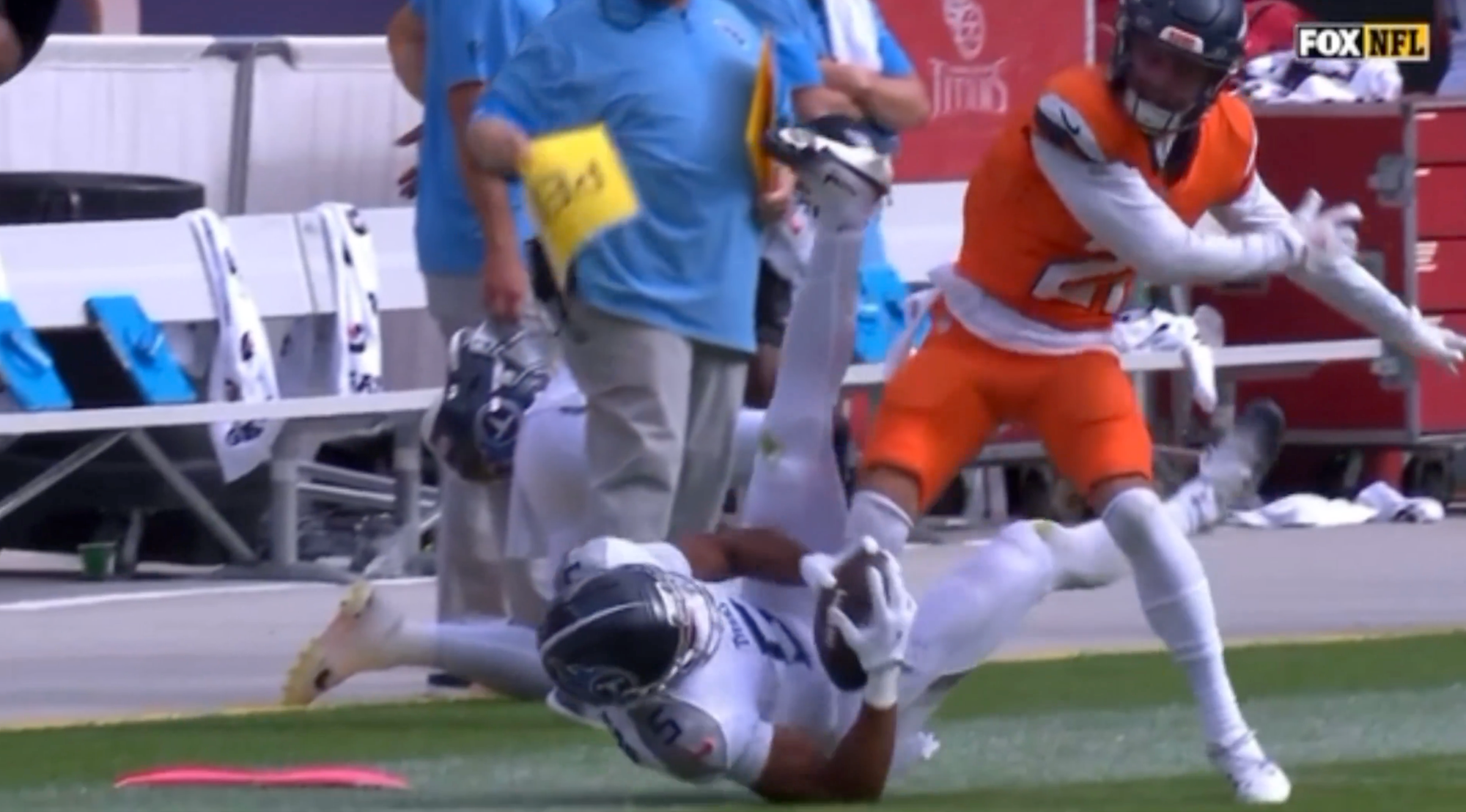
The Titans did not challenge the play and when asked about it after the game, Callahan stated he didn’t throw the flag because a foot wasn’t down and “an elbow doesn’t equal two feet,” which, by rule, it does.
Tennessee didn’t deserve to win the game, but the head coach didn’t do his part to help his team steal a win, either.