Four Ups, Four Downs: Week 3

Welcome to Four Ups, Four Downs, where we'll look at some of the good and bad from the previous week of NFL games. This week, we have receiver usage, coaching decisions, and quarterback struggles.
Up: Throwing To A.J. Brown
In Week 1, A.J. Brown had one target for eight yards. In Week 2, the Eagles threw at him more often, but eight targets only turned into five catches for 27 yards. Halfway through the Eagles’ 33-26 win over the Los Angeles Rams, it appeared there was a similar game plan, ignoring the receiver who had 3.3 yards per route run last season, second only to Puca Nakua, according to FTN.
The Eagles’ passing game has struggled through the first three weeks (16th in passing DVOA) but the biggest sign of life came when Philadelphia started throwing to Brown. Brown had one target in the first half but finished the game with six catches for 109 yards and a touchdown on 10 targets. Getting Brown involved immediately changed the vibe of the offense. Philadelphia averaged 1.5 yards per play and had -1 net passing yards in the first half before looking more like the best version of the championship offense.
With 12:22 left in the third quarter, the Eagles had a second-and-13 on their own 29-yard line. Brown was lined up wide to the right with DeVonta Smith next to him in the slot with the Rams in a two-high shell. The deep safety to that side started on the hash and, as the coverage rotated to more of a single-high look, continued to stay on top of Smith, which left an open lane down the sideline for a go ball to Brown, which went for 38 yards.
That impacted the next play. Brown, again, was lined up wide to the right with Dallas Goedert in the slot. With the ball on the right hash, the safety lined up further into the boundary. At the snap, Goedert ran a seam similar to Smith the play prior. The safety turned to face Brown and defend against another pass down the sideline, which left no one covering Goedert.
We’ve seen the Eagles have spurts as an unstoppable offense — we just haven’t seen much of that yet this season. The idea behind this team is that there’s so much talent on offense that there should always be something that can be a positive matchup against any opponent. The more the Eagles lean into that, the better this team should be.
Down: Raiders Identity
After an impressive opening week, the Raiders felt like they could be the frisky team some expected them to be this season. Two weeks later, the Raiders are 1-2 following a 41-24 loss to the Marcus Mariota-led Washington Commanders. In Year 1 under Pete Carroll, the Raiders still haven’t completely figured themselves out.
Las Vegas has used 11 personnel on 68.8% of offensive plays so far, which is the 12th-highest rate in the league, per SumerSports. With Brock Bowers and Michael Mayer, the Raiders were expected to be a heavy 12 personnel team that could do anything from those two tight end sets. Unfortunately, both tight ends have dealt with injuries that haven’t allowed the offense to use its personnel as intended. Last week, Bowers was hurt going into the Monday night game and was little more than a decoy and Mayer left the Week 3 game early.
Last year, Bowers had arguably the most impressive season for a rookie tight end, mostly done as a slot receiver. Per PFF, Bowers lined up in the slot for 43.1% of his snaps, inline for 39%, and out wide for 16.2% in 2024. So far this season, Bowers has been inline on 59.6% of his snaps, in the slot 29%, and out wide for just 10.6%.
With Bowers inline more, the Raiders aren’t keeping an extra player in to block when they’re in 11 personnel and that’s left some problems in pass protection. Geno Smith was pressured on 47.1% of his dropbacks in Week 3, per FTN. That’s on top of a run game that hasn’t been able to get going. The Raiders are 32nd in run block win rate, per ESPN, and Ashton Jeanty has averaged 0.8 yards before contact per rush, which is the sixth-lowest figure among running backs. At the same time, Jeanty is 11th among backs in the rate of avoided tackles forced. But the back isn’t blameless. According to Next Gen Stats, just 28.3% of Jeanty’s rushing attempts have more rushing yards than expected, the seventh-lowest rate among backs.
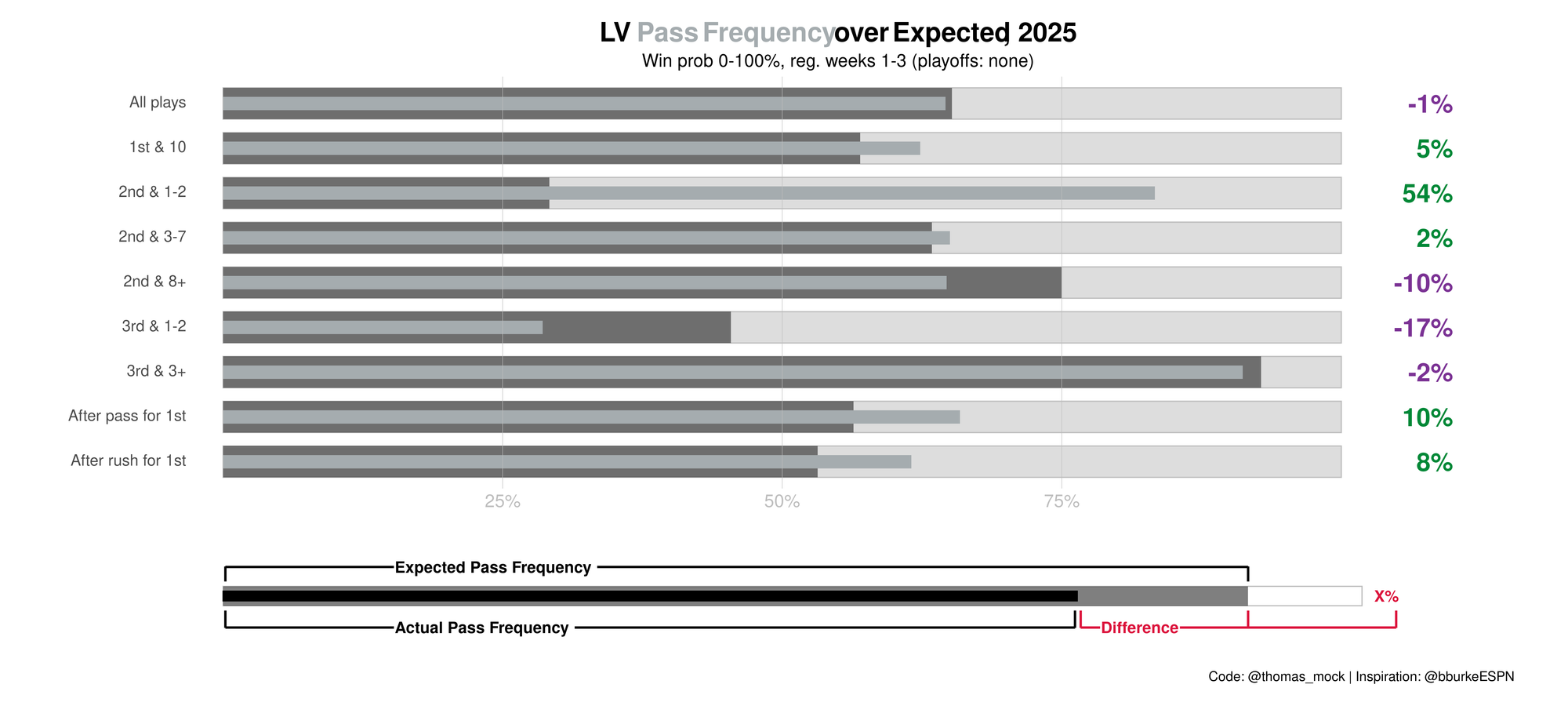
The Raiders now have one of the pass rates above expectation on second and short, where they have a 20% passing success rate. That’s led them to running the ball on third and short, which has led to a 40% rushing success rate — the lowest in the league, according to FTN.
Up: Jaxon Smith-Njigba, WIDE receiver
During the first two year of his career, Jaxon Smith-Njigba was a primary slot receiver. With the signing of Cooper Kupp during the offseason, there was a question about how the roles would play out with the top two receivers predominantly lining up inside. Well, there’s been little issue so far this season since Smith-Njigba has moved to the outside. He hasn’t just changed his role, he’s excelled at it.
Through three weeks, Smith-Njigba has lined up wide on 77.3% of his snaps. Against the Saints in Week 3, he had his highest outside rate of the season at 85.7% and 94 of his 96 receiving yards came outside. With the wide alignment, the Seahawks have used Smith-Njigba as more of a vertical threat. He already has half of the receptions of at least 20 air yards (four) as he did over the full 2024 season (eight).
Those vertical plays have worked great with the rate of play-action the Seahawks have run with Sam Darnold.
Smith-Njigba leads the NFL in receiving yards from a wide alignment and has averaged 5.2 yards per route run from there. Seattle has done an excellent job of allowing Smith-Njigba to still act as he would from the slot while lining up outside. On the deep shot, he still took an inside release to go down the middle of the field. On his touchdown catch, Seattle used motion with Tory Horton to widen the outside corner and free up space for Smith-Njigba to cross the field.
There’s a smoothness to Smith-Njigba’s routes that allows him to effortlessly break off routes. As an outside receiver, that’s allowed for more room in the middle of the field. Per Next Gen Stats, his 220 receiving yards on in-breaking routes are second only to Puka Nacua’s 231.
Down: Michael Penix’s Feel
A quick release was one of the selling points for Michael Penix as a passer. He was billed as a passer who could get the ball out quickly but also push the ball down the field. That hasn’t really been the case so far this season and in a 30-0 loss to the Carolina Panthers, Penix’s inability to push the ball was a detriment to the offense.
As a rookie, 15.1% of Penix’s attempts traveled at least 20 air yards. This year, that rate is 5.1% and he’s 0-for-5 on those throws. Against the Panthers, he attempted one deep pass (2.8%) and passed up the opportunity to be more aggressive. There’s something off with Penix’s internal clock. He’s quick to get to the checkdown, which he’s done at the second-highest rate in the league this season. He threw a pick-6 against Carolina when he had a chance to hit an open Ray-Ray McCloud, but without pressure, he moved straight to the checkdown and lofted a ball to Bijan Robinson that was jumped and taken into the end zone.
Then, later on a fourth down attempt, Penix was jumpy in the pocket without pressure and bounced an open pass to McCloud that would have picked up the first down.
From a clean pocket, Penix averaged -0.54 EPA per dropback in this game and now has negative EPA from a clean pocket on the season. That was not supposed to be how this Atlanta offense functioned with a second-year quarterback but the process has not been smooth. The Falcons are 24th in passing DVOA. They announced that offensive coordinator Zac Robinson will move from the coaches' box to the sideline and wide receivers coach Ike Hilliard was fired. That’s a lot of scrambling after the third week of the season, but the Falcons need to do something to make this work.
Up: Caleb Williams, in control
There was a lot to like from Caleb Williams in the dominant 31-14 win over the Dallas Cowboys. Williams played better in rhythm and found a ton of open space with Dallas defenders struggling to stay matched up in coverage. Williams was more patient in finding the holes in the coverage and did not have to force as many passes into tight coverage. Per FTN, Williams had his longest time to throw of the season but also managed to throw his lowest rate of passes into tight coverage and had the highest rate of open (two to five yards of separation) and wide open (five or more yards) targets this year.
The flea-flicker touchdown was the highlight but perhaps his best throw of the game was a 13-yard pass to Rome Odunze early in the fourth quarter. Williams was pressured immediately off a play-action dropback from under center. Williams lept and threw around Donovan Ezeiraku.
It’s an ok gain in the box score, but the throw was made from around the 18-yard line on the far hash and from a leap got to about the 34 outside the numbers. The number of quarterbacks who don’t bounce that pass is so small. Look at this base:
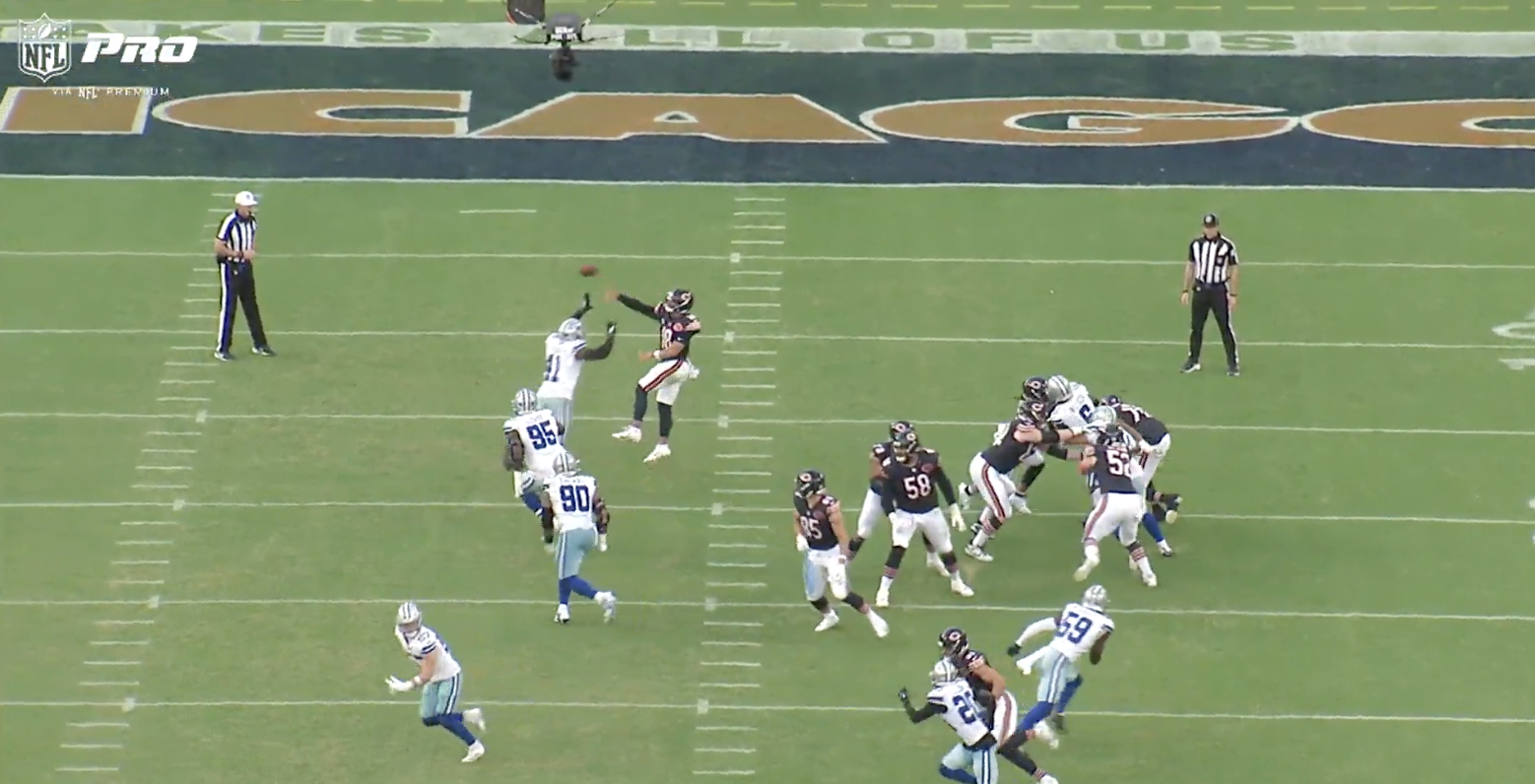
This is the type of arm strength and playmaking that made Williams such an exciting prospect. It was also a play emblematic of some of his success in this game, where he averaged 0.53 EPA per dropback under pressure. He looked fine in the Week 2 loss and much better in the Week 3 win — potential development that could continue as comfort grows in this offense throughout the season.
Down: Sean McVay still hates fourth downs
We’ll try not to cover the same game twice in these writeups but Sean McVay’s conservative nature on big fourth downs was a big piece in the Rams losing to the Eagles on Sunday. There were two fourth downs that McVay could have gone for that might have been enough to ice the game for the Rams.
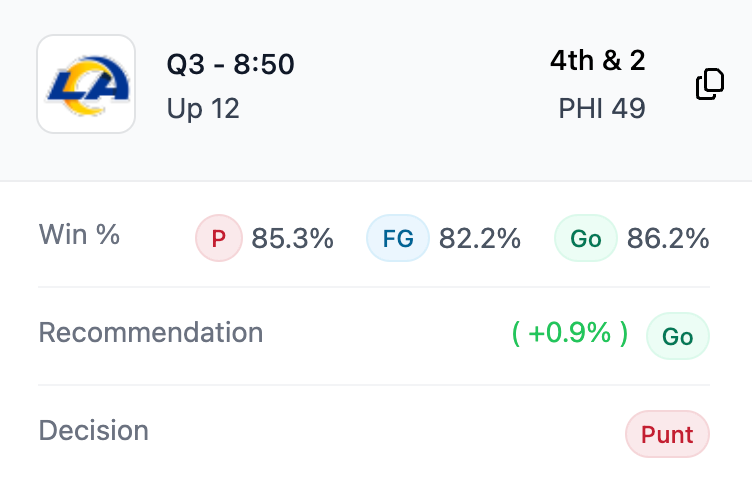
In the third quarter, the Rams were up 12 and faced a fourth-and-2 from the Eagles’ 49-yard line. Instead of going for it from midfield, which most teams now do regardless of the situation, McVay elected to punt. Philadelphia scored a touchdown on the following drive, cutting the Rams’ lead down to five.
In the middle of the fourth quarter, the Rams had another fourth-and-2, this time from the Eagles’ 18-yard line while still up five. Going for it here could have pushed the Rams further into the red zone and even failing would have had the Eagles starting deep in their own territory. Instead, the Rams chose to kick a short field goal, which was blocked.
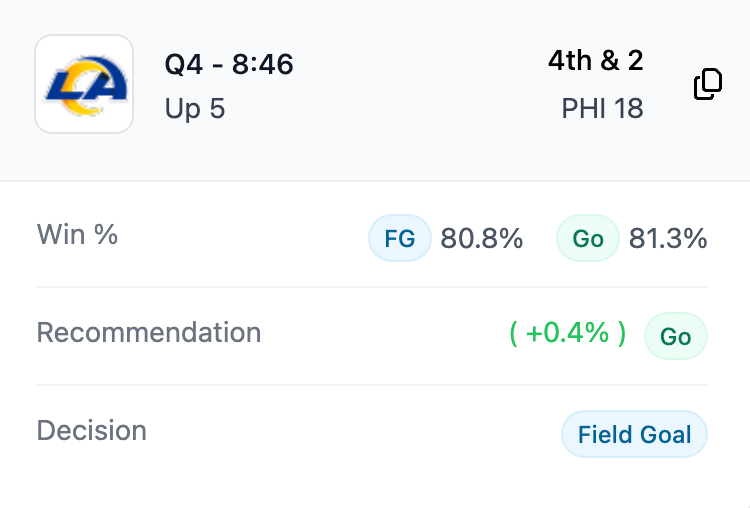
The Eagles again drove down the field and scored a touchdown on the ensuing drive to take a 27-26 lead with a failed 2-point try. The blocked kick might have also given the Eagles a tip for how to block the final field goal attempt late in the game. That block, a 44-yard attempt, was then returned for a touchdown by Jordan Davis.
Just one of those fourth-down conversions could have changed the game for the Rams. It was poor process that produced the worst possible results.
Up: Vikings Doing Stuff
The Rapture wasn’t supposed to come until Tuesday (if this is the last thing you’re doing beforehand, I’m sorry), but Jake Browning was in hell on Sunday.
Minnesota created pressure on 54.8% of Cincinnati’s dropbacks. The Vikings blitzed 48.4% of the time and generated a quarterback hit on 29% of dropbacks. That is a tough way to live and the Bengals didn’t do much living. It would be hard enough if the Vikings were just ultra aggressive but they were moving pieces all over the place on defense, making it nearly impossible to determine what was going to happen once the ball was snapped.
Has an NFL defense ever disguised like this?
— Alec Lewis (@alec_lewis) September 22, 2025
They go from an all-out blitz look. To a man coverage look. To a Tampa 2 look. To playing what looks like Quarters on one side and C2 on the other.
Just diabolical stuff. pic.twitter.com/qH5Ggd1jnQ
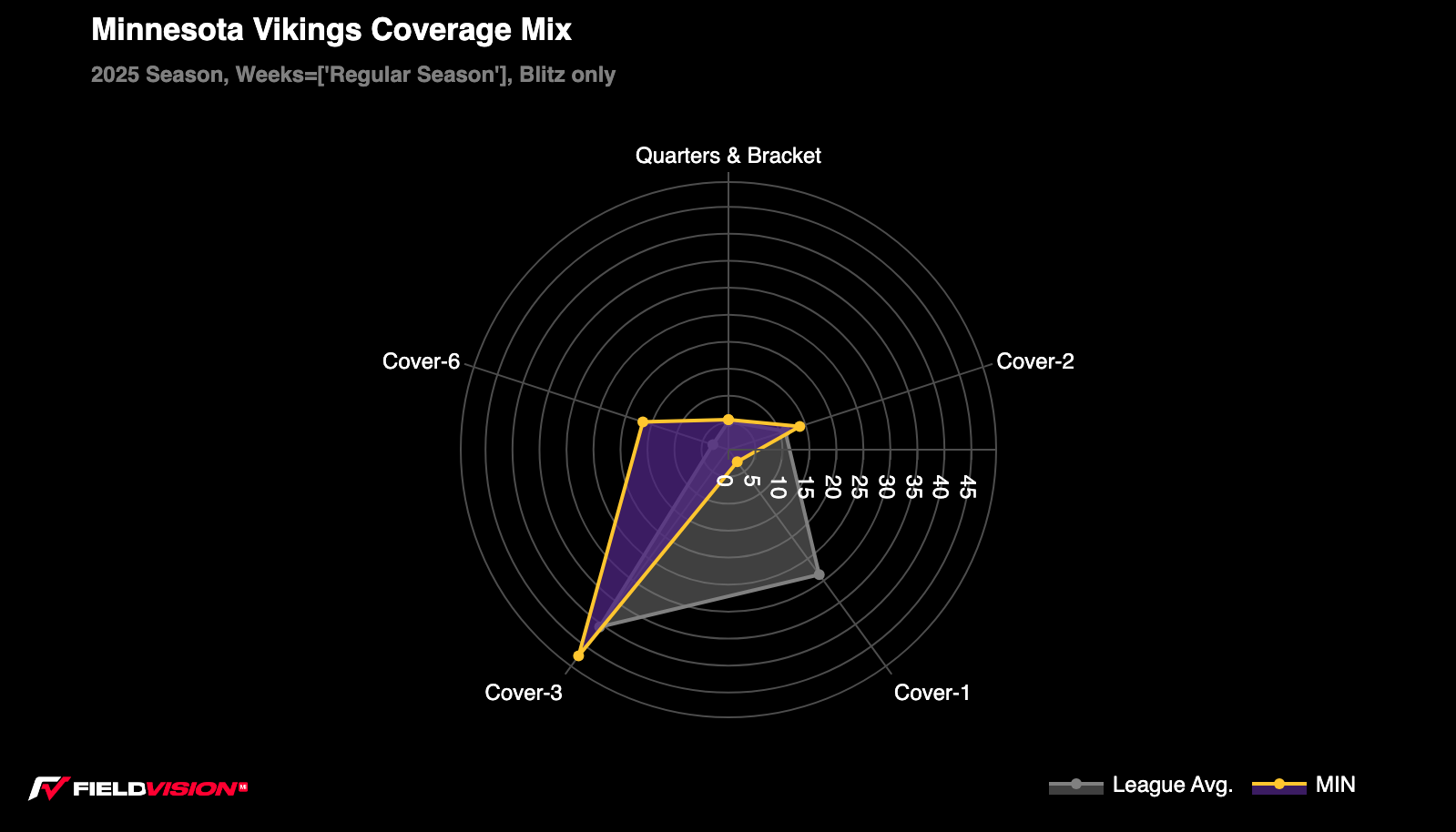
While many teams try to man up and play Cover-1 behind blitzes, the Vikings are still changing the picture more than any other team — playing a ton of Cover-6 but also throwing in Cover-3 and Cover-2 while barely playing any Cover-1.
This game against the Bengals jumped the Vikings from 18th in defensive DVOA to second.
The Vikings have already held two of three quarterbacks under a 40% success rate, with Caleb Williams (42.9%) behind the lone survivor. Browning had a 33.3% success rate in Week 3. It’s not just young or inexperienced quarterbacks Flores can feast on. Next week, the Vikings play the Steelers in Ireland. When Aaron Rodgers faced Brian Flores last season, Rodgers averaged 4.5 yards per attempt with three interceptions and a 38.9% success rate.
Down: The Dolphins Can’t Do The One Thing They Used To Do Well
Vibes weren’t high for the Dolphins entering the season but there was still a chance the offense would keep doing what it had done whenever Tua Tagovailoa has been on the field under Mike McDaniel — they can be an incredibly efficient offense. The Dolphins are decidedly not that through three weeks. Tagovailoa had a 38.2% success rate against the Bills on Thursday night with a bad interception as Miami dropped to 0-3.
There just aren’t any answers for the Dolphins, who have run a version of the same offense for the four years under McDaniel. At its best, Miami can get the ball out quickly and push the ball down the field because the quarterback has a quick release and the receivers are fast. Tagovailoa’s aDOT dropped last season while an inefficient run game was replaced with swing passes to De’Von Achane. This year, that aDOT is still incredibly low, but it’s an offense-wide problem.
In Week 3, Tagoaviloa had a 6.0-yard aDOT but just 21.1% of his air yards were charted as catchable, per FTN. That rate is 45.4% for the season, which is better than only Jake Browning’s 45%. Last year, Tagovailoa was 12th in the league at 58.9% and in 2023, he was fifth at 64.7%.
Defenses are now selling out to stop anything deep and keeping defenders to stop those intermediate, middle-of-the-field passes that have been so effective in the McDaniel era. Without those spots to rely on, this is a condensed offense that still needs to play fast to make up for an offensive line that has gotten worse since the Dolphins initially set up this offense to help hide it. There might not be any adjustments left, given the personnel, and it has left nearly every player unable to play to their strength. It’s currently a tough watch, and given the lack of change during the first three weeks — when McDaniel has unveiled a new layer of the offense in the past — it’s hard to feel confident in any of it getting better.