Four Ups, Four Downs: Week 4

On this week's Four Ups. Four Downs, we'll take a look at some defenses coming alive, opening up some offensive possibilities, and some disappointing quarterback play.
Up: Unleashing Abdul Carter
When the Giants drafted Abdul Carter, thoughts immediately arose about how to get him on the field alongside Brian Burns and Kayvon Thibodeaux. Those three pass rushers could be devastating to any opposing offensive line. The first three weeks were hit or miss, including Week 3 against the Chiefs when Carter spent most of the game off the line as an off-ball linebacker and only rushed the passer on 74.3% of his pass snaps.
Against the Chargers, Carter found his groove. According to Next Gen Stats, Carter had eight pressures, seven of which were quick pressures, and he averaged 1.91 seconds to pressure. Once Chargers tackle Joe Alt left the game, the Giants teed off on Justin Herbert, with Carter leading the charge.
Through the first three weeks, the Giants ranked 31st in the rate of stunts used at 7.4%, per MatchQuarters, but they leaned on those to mess with the Chargers’ offensive line.
Carter had a 0.79-second pass rush get-off against the Chargers, the quickest he’s gotten off the line through his first four games. He worked poor Austin Deculus with multiple moves, including a spin near the Chargers’ own goal line.
He followed that up by cleanly and quickly bearing Deculus around the edge.
Carter’s seven quick pressures were the most by a defender in a game this season and the most since Trey Hendrickson had seven in Week 9 of the 2024 season, which was the only such game last year. This pass rush isn’t going to get to face an injury-depleted offensive line every week, but this might have been a step to getting Carter into the right place and allowing him to fire off the edge instead of trying to move him around and force him on the field.
Down: Green Bay end-of-game management
With 1:15 remaining in overtime, the Green Bay Packers had the ball on the Dallas 25-yard line with two timeouts remaining. Down by three after the Cowboys kicked a field goal on the opening overtime possession, the Packers could have won with a touchdown. After a six-yard pass to Romeo Doubs put the ball at the 19, Green Bay had a 72.2% win probability, according to ESPN.
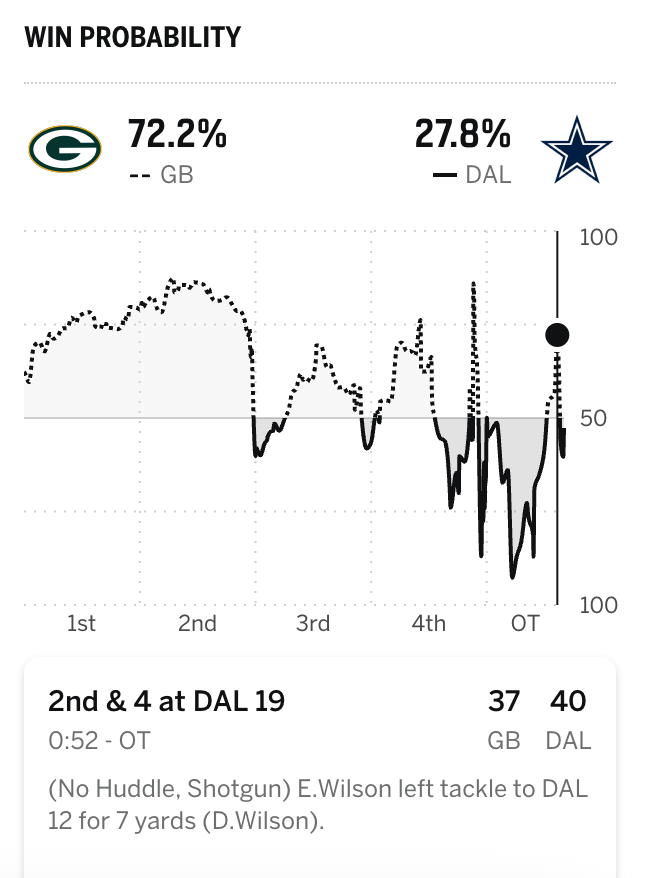
The Packers didn’t throw a ball into the end zone until the final play from scrimmage, which barely touched the ground before the game clock went to all zeros. Green Bay’s following plays were a seven-yard run by Emanuel Wilson, a poorly executed screen to Matthew Golden that lost three yards, and a checkdown to Wilson for a loss of one. The checkdown came after the Packers tried to suck the Cowboys in with the same screen action of Golden on the other side of the formation.
Here’s the blown-up screen:
Now here’s the screen motion in an attempt to get one of the deep routes off it. Despite the Cowboys only having two immediate defenders to that side of the ball, they didn’t care about the screen and the minimal gain that might have been. Both Reddy Steward (27) and Trevon Diggs played both routes, staying between the screen from Golden and the half-sell of a potential block from Dontayvian Wicks, while Markquese Bell ran with Romeo Doubs into the end zone.
Throughout the second half, the Packers stuck to the ground with a 50-50 run-pass split on early downs, despite the Cowboys entering the game as the league’s worst pass defense. The pass had been successful in this game already, with Love finishing the game with 0.53 EPA per dropback and a 60.3% success rate, per FTN. The Packers let up on the gas in the second half and inexplicably slammed on the brakes at the end of overtime to take a tie.
Up: Xavier Worthy’s gravity
Without Xavier Worthy in the lineup, the Chiefs' offense reverted to its previous condensed struggles. There’s only so much an offense can do when the 2025 version of Hollywood Brown is the field-stretcher. Worthy hasn’t been a consistent vertical threat during his career, but his presence helped open up the offense against a struggling Baltimore secondary.
Worthy had an instant impact in his return to the field following his Week 1 shoulder injury from a collision with Travis Kelce. He had a 16.6-yard aDOT, per PFF, a figure he only beat twice during his rookie season, and those came in games with two and three targets. Worthy finished the game with five catches for 83 yards on eight targets. His speed was used all over the field.
The Chiefs motioned him across the formation and saw man coverage against Marlon Humphrey. Humphrey never fully got set and flailed in an attempt to get his hands on the receiver. Worthy got behind the corner for a free run down the sideline for 37 yards.
He also had an end-around, opposite motion and run action to the other side.
On the touchdown to Hollywood Brown, Worthy started in the backfield and a run fake to Kareem Hunt brought in the deep safety, which opened up the end zone for Brown.
With Worthy in the lineup, the Chiefs were able to open up the middle of the field. It was a mix of everything the Kansas City offense has wanted to do over the past few seasons. The deep shots were open but just as importantly, it opened up the middle of the field for Patrick Mahomes to hit off of quick game.
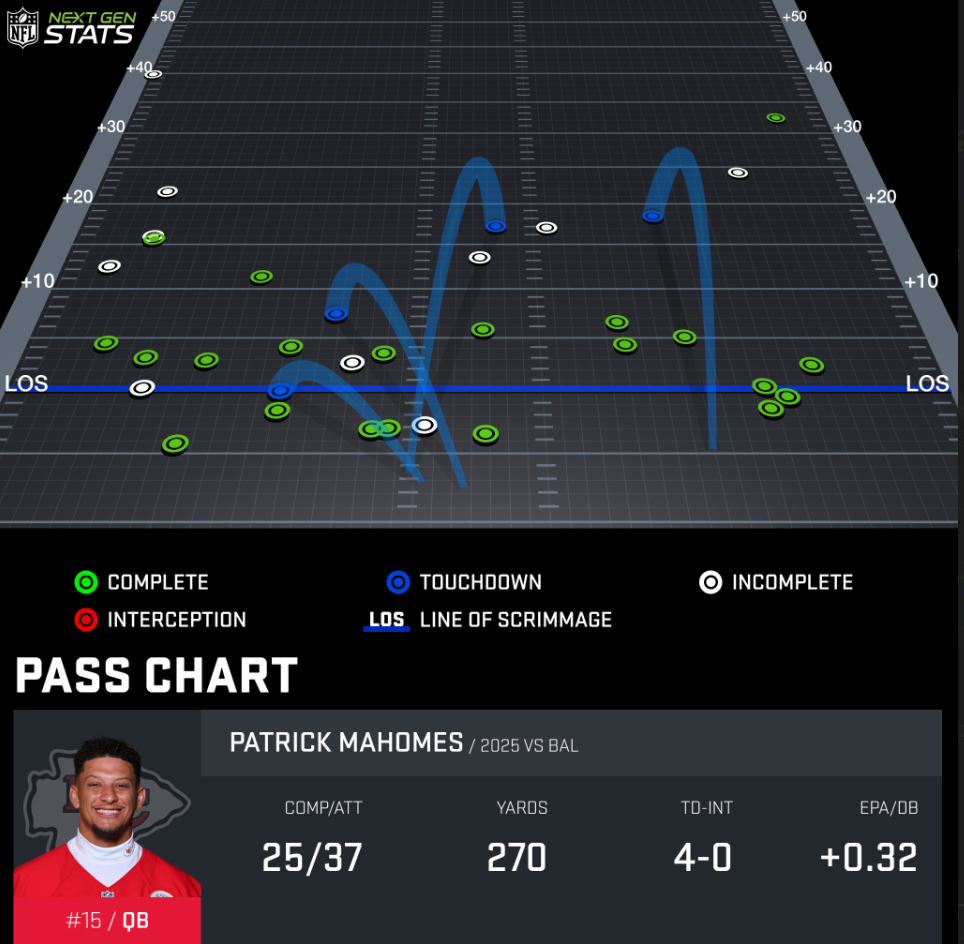
This is closer to what the Chiefs expected the offense to look like and it should develop more when Rashee Rice comes back to the lineup.
Down: Carson Wentz’s internal clock
A great offensive system and supporting cast can only do so much if the quarterback’s feel in the pocket is nonexistent. The Vikings have created an environment that has allowed quarterbacks to succeed. Even in the 24-21 loss to the Steelers, Wentz averaged 7.6 yards per attempt and had positive EPA per dropback. But he was sacked six times, often failing to feel the pressure. This has been a consistent Wentz trait, dating back to his time with the Eagles.
In his two games played, Wentz has been sacked on 29% of his pressured dropbacks. That’s the third-highest rate among quarterbacks behind J.J. McCarthy and Jaxson Dart, both in the 40s, with less playing time.
When Wentz has been able to get the ball off under pressure this season, he’s been fine. He’s 10th in EPA per dropback when pressured, per FTN. The answers are there, but the worst of Wentz comes when his internal clock doesn’t go off. His bad sacks were on third downs and in the red zone, which potentially cost the Vikings points. Wentz has a league-high 28.6% sack rate on third downs — though the one player worse was McCarthy.
With the Browns and Myles Garrett on the way, the Vikings could be facing more issues with injuries along the offensive line. Christian Darrisaw is back, but Brian O’Neill is out and Ryan Kelly is dealing with a concussion. Both of those injuries happened last week in Dublin, with guard Donovan Jackson already out. Cleveland is sixth in pressure rate and fifth in time to pressure, according to Next Gen Stats. If there’s something that has and could lower the floor of this Minnesota offense, it’s going to be the quarterback’s play under pressure.
Up: Plays off the tush push
Even the Eagles are tired of the tush push dialogue. Against the Buccaneers, the Eagles ran multiple plays out of a sneak formation. In the first quarter, on a first-and-goal from the 2-yard line, Jalen Hurts came out under center in a sneak position, but there were no teammates behind him. Instead, the Eagles had a close diamond formation to the right. When the ball was snapped, Hurts underhanded the ball to Dallas Goedert, who followed blocks into the end zone for a touchdown.
In the third quarter, the Eagles had a third-and-2 from the Tampa Bay 6-yard line. Philadelphia came out in the typical Tush Push formation, but Saquon Barkley took a handoff and ran in with a wide-open side of the field for a touchdown.
These plays work two-fold. While defenses are selling out to stop a play that has been nearly unstoppable since the Eagles started running it in this form, the offense now has a counter that has led to two untouched touchdowns. That could give opposing defenses hesitation on completely selling out with all 11 defenders to stop the sneak… which, in turn, could give the Eagles more leverage to sneak.
Perhaps the biggest takeaway here, though, is that the Eagles didn’t face all that many third-and-shorts in this game to begin with. Philadelphia picked up a first down on 25.6% of their early down plays, which was their highest rate of the season. It would be a borderline top-10 rate for this season and around what they averaged last season, which ranked 14th. The Eagles had a similar rate of early-down conversions against Dallas, but were down at 17% in their two other games.
Down: Geno Smith throwing deep
These past two games have arguably been the worst two since Geno Smith became a full-time starter again. Smith’s strengths have been his ability to fire in the face of pressure and still remain accurate while he takes shots down the field. He hasn’t been able to do either of those things this year. He has two games this season without a completion of 10 or more air yards. Smith is 16th in accuracy on throws of 15 or more air yards on the season, which ranks 16th, but he’s 29th in DVOA on those throws. He’s forced the ball into tight windows and that’s led to a few turnovers. That can always be an issue with Smith, a quarterback who wants to hunt for big plays, but the connection on those big plays hasn’t been enough to even balance out the mistakes.
We’ve talked about the Raiders’ personnel issues in previous versions of Four Ups, Four Downs and the lack of a true outside receiver combined with the lack of explosiveness from Brock Bowers while dealing with an injury, plus the lack of 12 personnel usage without Michael Mayer, has forced the Raiders into a static vertical passing game that hasn’t found success to this point in the season. He has the ninth-lowest adjusted completion percentage on deep passes this season. Last year, he had the ninth-highest, per FTN.
Smith has the third-highest turnover-worthy throw rate at 6.3%. The two players ahead of him, Carson Wentz and Brock Purdy, have not played in all four games. It’s not the type of company Smith wants to keep and it’s not what was expected when he was traded to the Raiders.
Up: New England's Pony Personnel
Putting two running backs out on the field together is something that sounds good in the offseason during training camp when those looks don’t face a lot of real defense. “Running back X is catching more passes out of the slot,” is a related oft-repeated training camp line. It’s difficult to pull off during the regular season because, for plays to have success with two backs on the field, the offense has to be able to keep the threat of the run and the pass. Passing becomes the hardest part of that because with two running backs, the vertical element in the concepts is usually erased. Few running backs are as good at going down the field as the typical third receiver. That condenses what the offense can do in the formation, and it’s often scrapped.
The Patriots, though, are a team that’s been doing some fun things with Pony personnel. New England has gotten combinations of Rhamondre Stevenson, TreVeon Henderson, and Antonio Gibson on the field at the same time.
Against the Dolphins, the Patriots got Henderson open on a wheel route from a split back look, after using motion to indicate man coverage and running a pick on the outside.
This past week against Carolina, New England had a few different looks to create explosive runs with two backs on the field. Henderson had an end-around while lined up as an outside receiver.
The Patriots used Henderson on jet motion and faked the handoff to open space for a 22-yard Stevenson run.
Then the Patriots gave Gibson the ball on a jet sweep with Henderson in the backfield.
It’s a fun element to the run and pass game that has allowed the Patriots to be one of the more versatile offenses in the league through four weeks. They’re eighth in passing DVOA on the back of Drake Maye, and they’re 24th in rushing DVOA, but these types of looks have allowed the Patriots to have some of their best success on the ground.
Down: Any help for Cam Ward
The Titans’ season is getting away from them quickly. Tennessee is 32nd in offensive DVOA, and there does not look to be much progress on that side of the ball. First overall pick Cam Ward has been fun at times, but inaccurate and under duress for most of his dropbacks.
Ward is 34th among 36 quarterbacks in accuracy rate and 32nd in adjusted completion percentage. At times, he’s trying some throws that he shouldn’t be but he also isn’t getting a lot of help from the passing concepts or his receivers. Ward has the second-lowest expected completion percentage, per Next Gen Stats, based on the throws he’s attempted and where the receivers are when those passes are thrown. Of course, he’s completing less than expected, even based on that, but it’s a difficult position to be in for a rookie.
Ward has thrown the second-highest rate of attempts into tight coverage, per FTN. He also has the 11th-highest rate of wide-open targets, but that’s mostly from Ward buying time in the pocket and creating something to come open. That's gotten him into just as much trouble as it has bailed him out of it. Watching Ward, it’s clear he gets it, but it’s been difficult for his processing to play out in a productive way when receivers can’t get open and there’s not a lot of scheme helping him out. It feels like a waste of a player who could be much better than the first quarter of his rookie season has allowed.