The Watchlist: Week 1

Welcome to the first edition of The Watchlist. Each week, we’ll go over five things between players, matchups, and trends, to keep an eye on for the upcoming week of games. With this being Week 1, there’s a lot of projection and we’ll be seeing everything for the first time, so this week’s Watchlist focuses on some of the things we’re looking forward to the most.
1. Micah Parsons in Green Bay
It’s not really possible to start anywhere other than this. The Green Bay Packers acquired one of the league’s best defensive players just a week before the start of the season, and he’ll make his debut against a divisional rival and one of the best teams in the conference.
The 2024 Packers finished the season fourth in weighted defensive DVOA but still lacked a player who could wreck a game on his own and demand attention along the front seven. So much of Green Bay’s defensive success came from turnovers, forcing the second-most turnovers per drive according to FTN. That was combined with a pass rush that ranked 10th in pressure rate while blitzing at the fifth-lowest rate in the league. Productive, sure, but now add Micah Parsons.
Parsons can obviously win one-on-one, but what stands out is how the defense can move him around anywhere to create the mismatch they want. Last season, when Washington Commanders center Tyler Biadasz was out, the Cowboys lined Parsons up directly over the backup center and let him go for an immediate sack.
He can line up pretty much anywhere and still be a threat as a pass rusher.
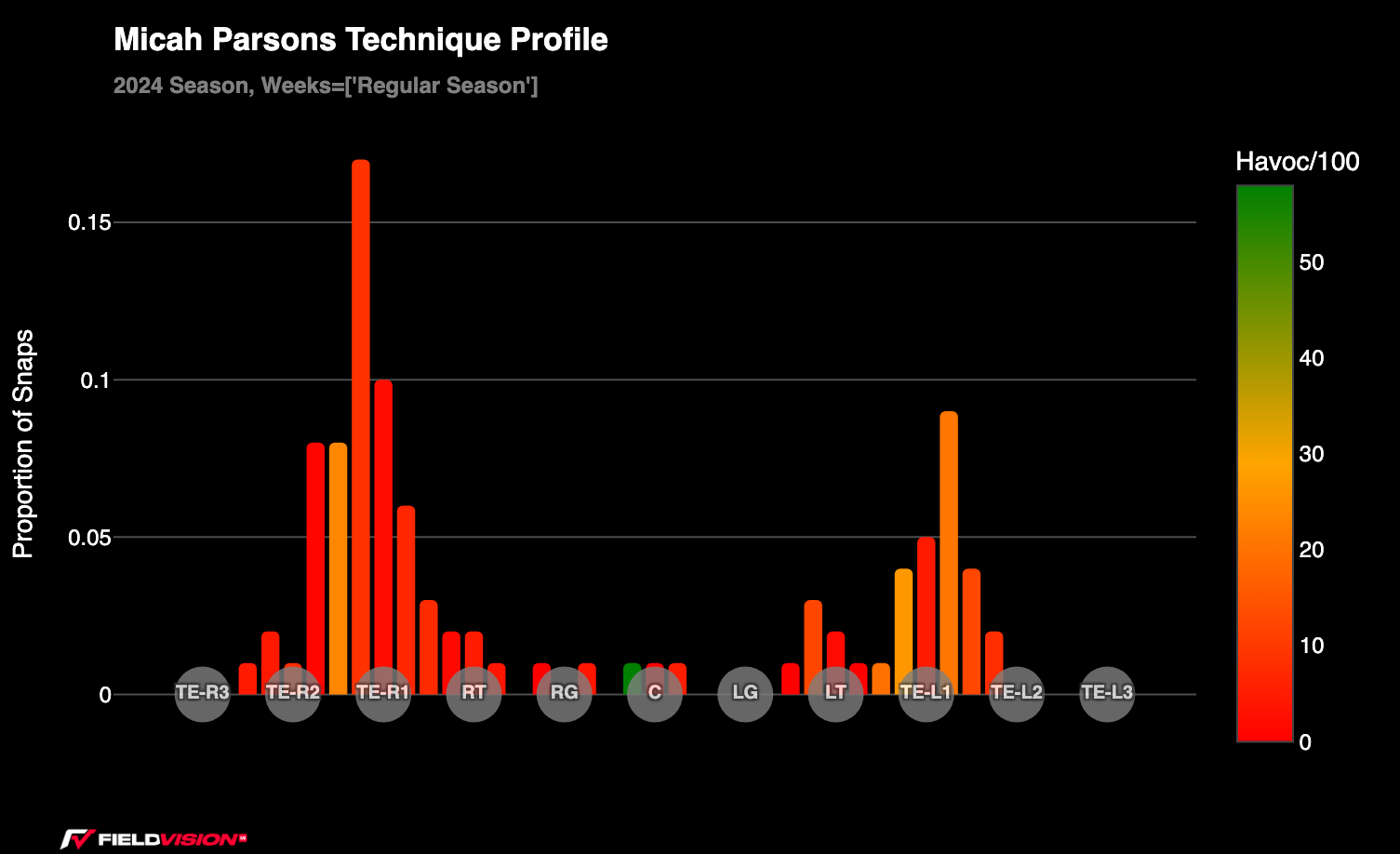
That can include picking his spot against a weak link in an offensive line, even if it’s inside.
Detroit’s interior offensive line could be a work in progress after the retirement of Frank Ragnow and the loss of Kevin Zeitler in free agency. The Lions will have second-year sixth-round pick Christian Mahogany, Graham Glasgow, and rookie second-round pick Tate Ratledge playing inside. Testing that interior could be how Green Bay gets an advantage in the trenches.
For as much as Jared Goff has improved during his tenure in Detroit, he’s still one of the most impacted passers when pressured. Last season, only Joe Flacco had a bigger drop in DVOA when pressured versus not pressured (-148.9%). Goff had his worst game of the season against Washington in the playoffs when the Commanders consistently created pressure, and the Lions couldn’t counter. When Goff is pressured, he’s also more prone to throw deep. According to Next Gen Stats, Goff’s rate of deep throws in 2024 went from 4.5% when not pressured to 10.1% when pressured (though he still had the second-lowest aDOT overall when pressured at 5.4 yards).
Forcing Goff to hold onto the ball and make throws he doesn’t otherwise want to make could be the path for this Packers defense to make an immediate impact.
2. Lamar Jackson and Josh Allen
The two most recent MVPs (you could make an argument the seasons could be switched) and what should be the two best teams in the league — what’s not to be excited about? In a sense, this game doesn’t mean a whole lot. Win or lose, we would expect each of these teams to win its division and be in the race for the top overall seed in the AFC. That could be the ultimate consequence of this game, but the Bills lost to the Ravens in Week 4 last season and finished as the No. 2 seed behind the 15-1 Kansas City Chiefs, while the Ravens were the third seed. But because these teams are so close, it could always be in play.
How important is Sunday night's Bills-Ravens even though it is just Week 1? Our sims have the Bills win the SB 18.6% with a win, 12.0% with a loss. Sims have the Ravens win the SB 24.5% with a win, 16.8% with a loss. Winner has a roughly 45%-15%-15% advantage over the loser and KC for the 1 seed.
— Aaron Schatz (@aaronschatz.com) 2025-09-05T17:34:24.956Z
What we’re going to get, though, is what could be our look at what the next evolution for both of these teams will be.
Last year, Lamar Jackson was the league’s best pocket passer. With 45.6% DVOA from the pocket, his lead over Josh Allen at No. 2 was bigger than the gap between Allen and the 11th-ranked quarterback. So much of that came from Jackson standing confidently in the pocket and waiting for routes to open up.
The Ravens did an incredible job using heavier personnel packages (12 and 22) to condense the defense, but used route spacing to create wide-open windows in the passing game. Baltimore used the lowest rate of 11 personnel in the league at 27.8%, per SumerSports. Tight end Isaiah Likely will miss Week 1 and fullback Patrick Ricard hasn’t practiced since mid-August. That could force the Ravens into more three-receiver sets with Raashod Bateman, Zay Flowers, and DeAndre Hopkins.
If Hopkins can play as more of a power slot in 11 personnel, it could give the Ravens a similar feel to their 12 personnel looks with Mark Andrews still on the field. Don’t overlook Andrews despite how the season ended in Buffalo. Andrews was sixth and yards per route run and second in DYAR among tight ends during the regular season.
Josh Allen was the best quarterback under pressure last season by EPA and the Ravens want to bring that pressure. In the Week 4 game, Allen was pressured on 28.3% of his dropbacks, per FTN charting. He held onto the ball for an average of 2.96 seconds with an 11-yard aDOT. All of that flipped in the playoff meeting. Allen averaged 2.25 seconds to throw with a 6.1-yard aDOT, which limited Baltimore’s opportunities to create pressure. As a result, Allen was only pressured on 13% of his dropbacks in the Divisional Round.
3. Caleb Williams & Ben Johnson vs Brian Flores
There are a number of new coach/quarterback pairings this season (we’ll get there), but none will have more of a spotlight in Week 1 than Ben Johnson and Caleb Williams in Chicago. Part of that is due to the Monday Night Football platform, but overall, this is the first look at last year’s No. 1 overall pick at quarterback and the league’s hottest head coaching candidate for the past three seasons. Their first test comes against one of the most aggressive defensive coordinators in the league.
Caleb Williams’s rookie season was uneven, but in the general conversation, the lows have been talked about much more than the highs. Williams had about eight games worth of play that showed top-10 ability. Of course, the bad games had the efficiency of one of the least productive quarterbacks in the league and those games outweighed the good in the season overall. But bad quarterbacks don’t tend to have a sample — albeit scattered — that looks so promising.
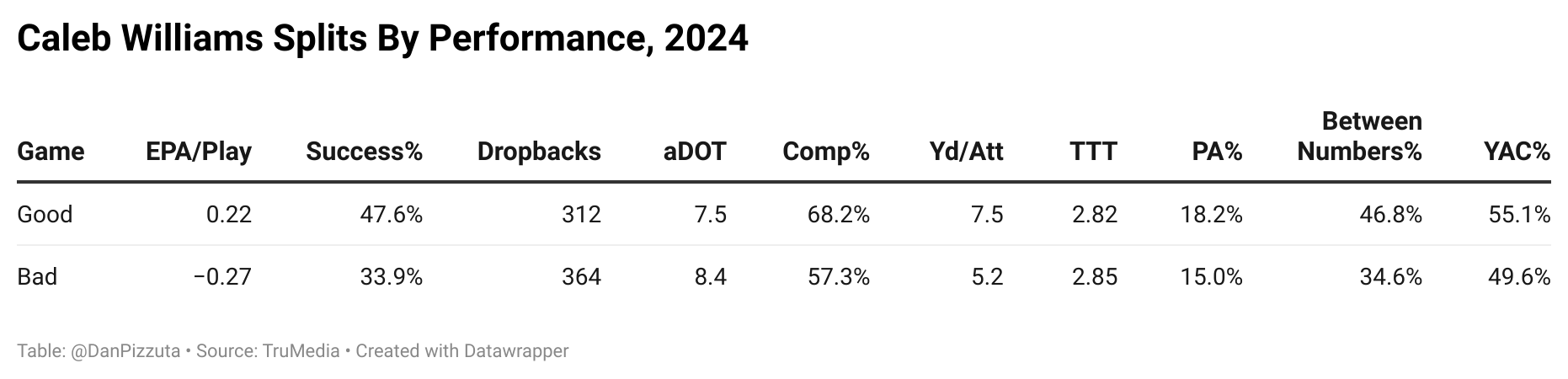
One of those good games was a Week 12 meeting against the Vikings. It was the rookie’s first game playing Minnesota and it was one of his best performances. Williams got the ball out quickly to beat the blitz (2.31 average time to throw) and was pressured on just 12.7% of dropbacks. The Bears ran a lot of screens but also Williams had a few quick-hitters into the right slot area.
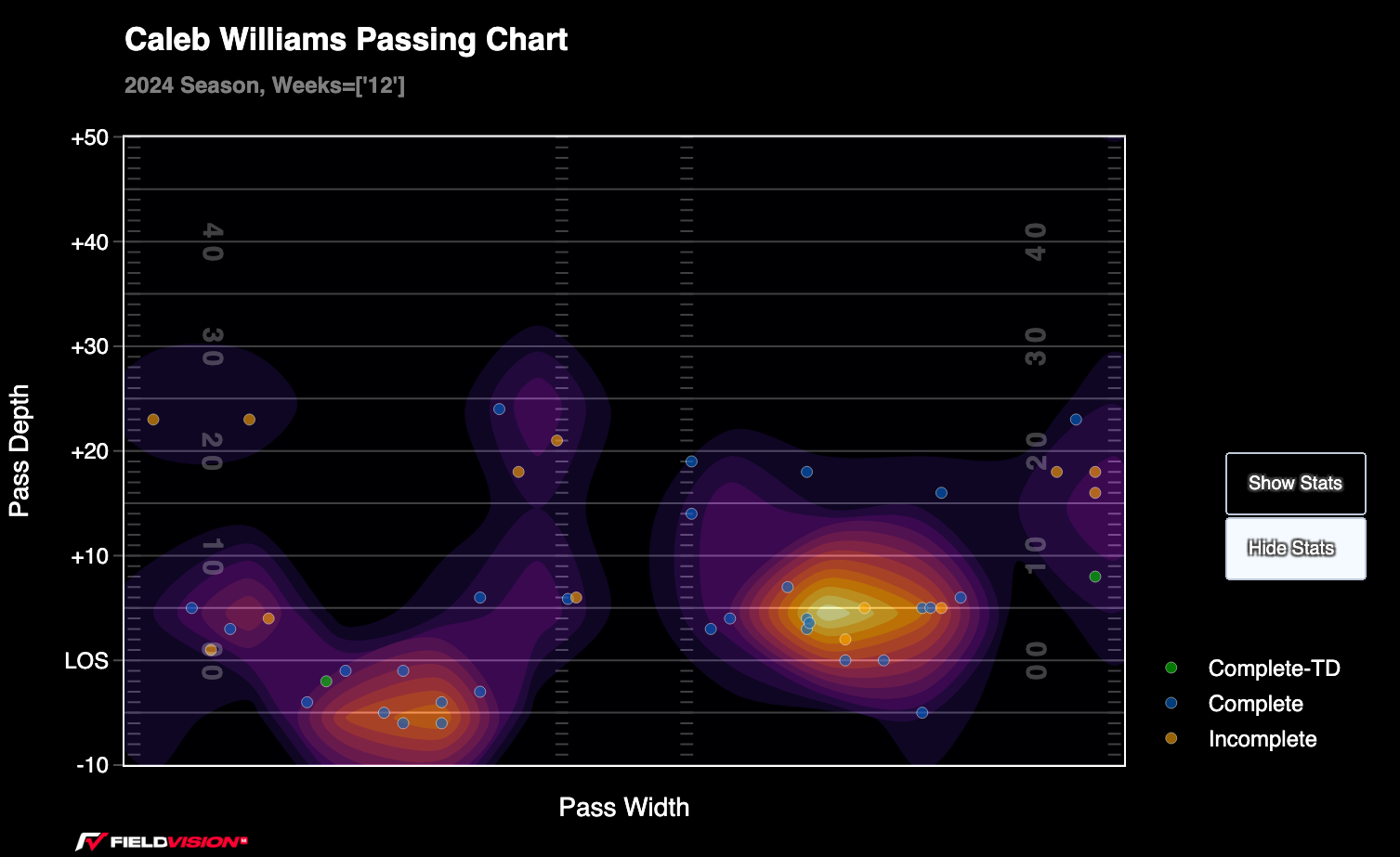
In Week 15, the Vikings upped their blitz rate and Williams went into creation mode. He hung onto the ball for an average of 2.98 seconds and was pressured on 42.9% of his dropbacks.
With the Lions, Johnson had a game plan with Jared Goff that looked closer to the good Williams game. In two games against Minnesota in 2024, Goff averaged a 5.8-yard aDOT and 2.38 seconds to throw. Spamming the short area, replacing the blitzer, and forcing the Minnesota defense to tackle were the main themes of the offensive plan. Forcing Williams to be patient enough to stay within that type of environment would be a big step forward for the offense.
It’s also what makes this a different job than what Johnson was tasked to do in Detroit. That centered around giving Goff an environment where he could play to his strengths and not have to overextend himself to lift the offense. With the Bears, Johnson’s responsibility is to rein in the quarterback and have him play as if not everything is on his shoulders.
4. Arizona’s Defensive Changes
For those keeping an eye on such things, the Cardinals defense has been one of the more fun watches in the league. With a lack of overall talent across all three levels of the defense, this was a unit that tried some shit to cause havoc and try to match up when outmanned by the opposing offense. With the relative lack of talent, Arizona still finished 14th in defensive DVOA. There should still be some of that chaos in 2025, but the talent has (potentially) improved.
This offseason, the Cardinals added Calais Campbell and Josh Sweat along the defensive front — as well as retained midseason trade acquisition Baron Browning on the edge. The team also drafted Will Johnson at corner to play with Max Melton and Garrett Wilson, who was one of the league’s best slot corners last season.
Not many defenses revolve around the play of a safety, but the Cardinals weaponize Budda Baker — or he weaponizes himself and the Cardinals don’t really have a choice — about as good as any other defensive back in the league. Baker lines up all over and Arizona was consistently in three-safety looks, which maximized how Baker could play. He’s a bullet against the run when he finds an opening.
Because of how the Cardinals aligned their safeties, teams didn’t attempt to throw deep on them often. Per FTN, just 8.9% of opposing passes traveled at least 20 air yards, which was the third-lowest rate in the league.
In coverage, Arizona was still a majority Cover-3 team.
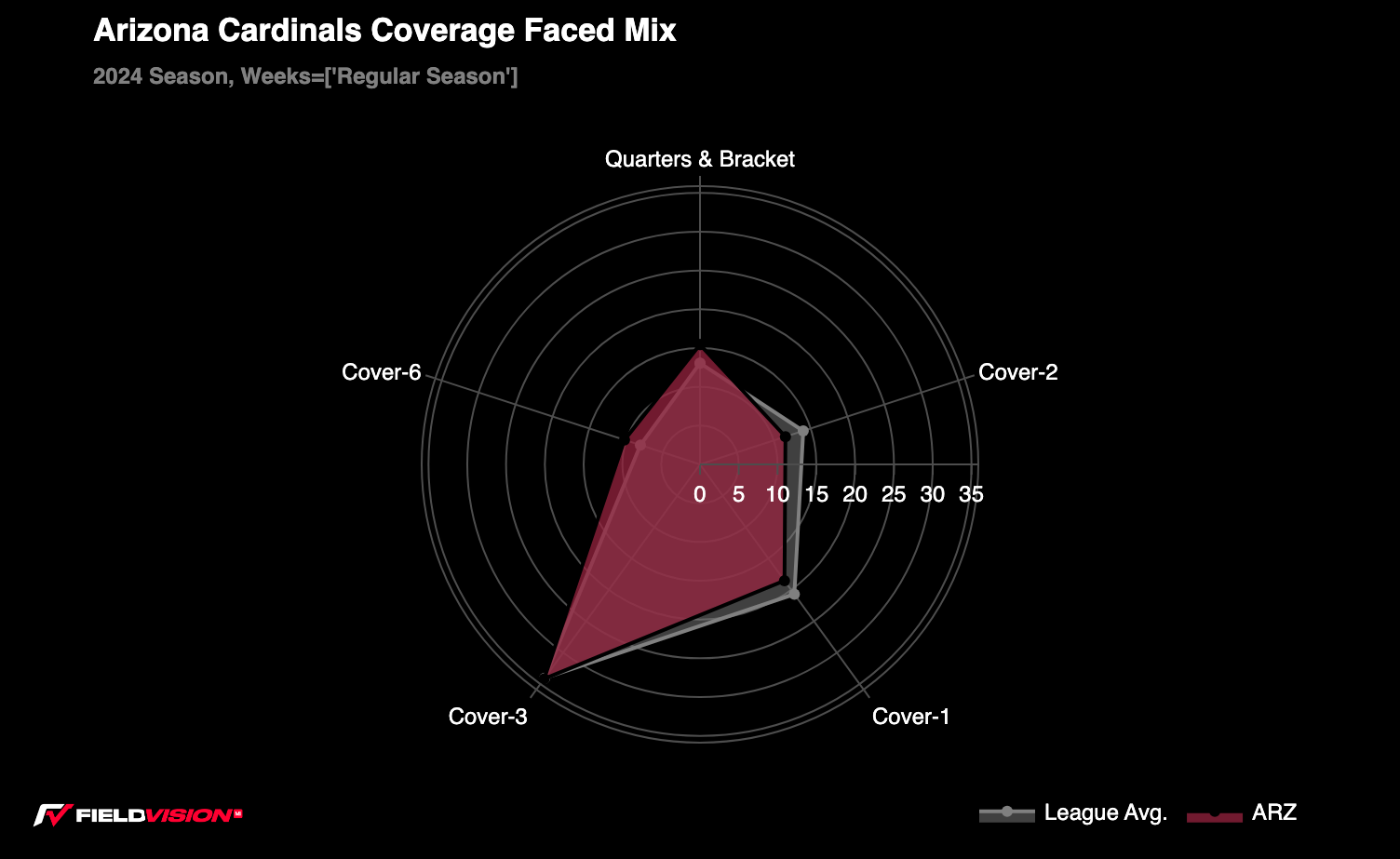
Getting there was a different story. Per MatchQuarters, the Cardinals had the fourth-highest rate of middle of the field disguises (showing single-high presnap and rotating to two-high or vice versa), and with three safeties on the field, there could be all kinds of looks deep in the secondary.
The Cardinals also ran the sixth-highest rate of sim pressure up front, giving the quarterback even more to keep an eye on after the snap. Arizona was in the top tier of defenses doing both of those things at a high rate.
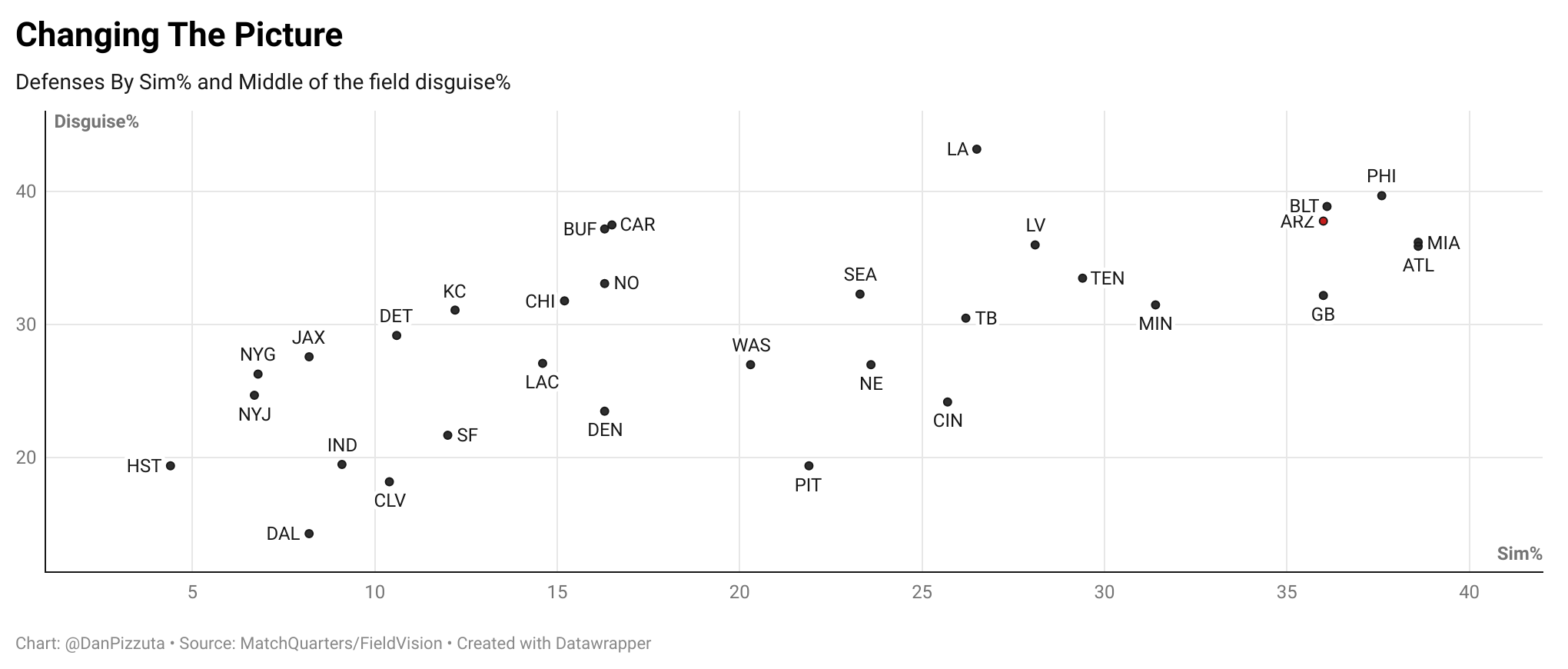
We’re going to see the first version of this new defense against a New Orleans Saints offense that is projected to be one of the worst in the league. Spencer Rattler is the starting quarterback, and while he can make a highlight throw on occasion, he can be coaxed into making bad decisions. If the Cardinals are constantly changing the picture in front of him and making the most of their opportunities, this could be a big coming-out party for head coach Jonathan Gannon and defensive coordinator Nick Rallis.
5. All the Changing Offenses
Let’s speed run through a few of the new-look offenses that we’ll get a glimpse of in Week 1.
Las Vegas Raiders: What does Chip Kelly bring in his return to the NFL? He has an accurate quarterback, a dynamite running back, and the threat to do anything out of 12 personnel. Last season, the Raiders had the league’s highest rate of 12 personnel while having the third-highest pass rate with two tight ends on the field. Also keep an eye on rookie Dont’e Thornton, who is in line to start at X. He has 4.3 speed at 6-foot-4 and has shown more glimpses as a real receiver and not just a big-play threat in the preseason.
Houston Texans: It’s all about protection for C.J. Stroud. The offensive line might not even have to be good; it just needs to have a plan. Last season, the Texans had the second-highest rate of pressures attributed to the offensive line, per FTN, as it impacted how Stroud approached the game. Enter Nick Caley. The former Rams tight ends coach and pass game coordinator should have a better plan and in-game adjustments than his predecessor, Bobby Slowik. The first game is a tough task against the Rams and Jared Verse, who was fourth in pressures last season.
Jacksonville Jaguars: Is Liam Coen just what Trevor Lawrence needed? After the Doug Pederson offense went stale, this might be Lawrence’s first shot at running a modern NFL offense. Expect more quick releases and throws to the middle of the field on top of a screen game that could do wonders to keep the offense ahead of the sticks. Coen was able to use that combination to guide Baker Mayfield to the best season of his career last year in Tampa Bay.
Seattle Seahawks: Will the Klint Kubiak system insulate Sam Darnold and the rest of the offense from the offensive line? If the wide-zone play-action scheme works, this could be a successful offense but if the team has to rely on straight dropbacks, it could cause problems. Darnold was 22nd in EPA per dropback under pressure with the Vikings last season — an issue that derailed Minnesota’s season as protection broke down late in the year.
Tennessee Titans: Cam Ward gets a bad draw opening the season against the Broncos defense in Denver. Ward wants to try to make some throws. Among 49 quarterbacks with at least 15 attempts in the preseason, Ward tied for 16th in aDOT (10.3). We’ve seen a connection with Calvin Ridley in the preseason, but what does the offense look like outside of that? Tyler Lockett is the starting slot, and it appears that rookie Elic Ayomanor will be the second outside receiver, with fellow rookie Chimere Dike mixing in.